Türkiye believes the wars of the 2020s have broken the old logic that rich countries with big armies automatically dominate conflicts. At Istanbul’s giant defence expo, Ankara pitched itself as a middle power adapting faster than the West.
✍ By Iftikhar Gilani, Indian Journalist
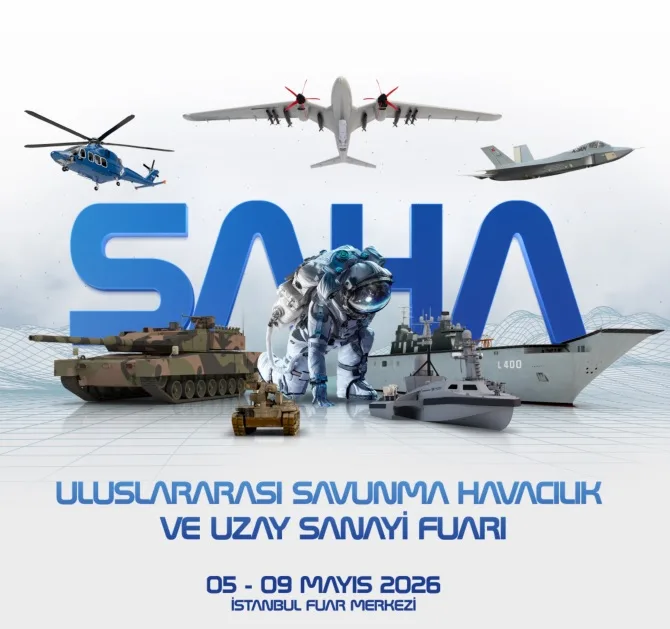
In the heart of the Turkish metropolis, Istanbul, convoys crawled through layers of security barriers outside the main expo centre leading to SAHA 2026 International Defence and Aerospace Exhibition, one of the largest exhibitions of its kind in the world.
The first thing that strikes one is not the size, though it is vast, nor the noise, though it hums with thousands of conversations in dozens of languages. It is the sense that the world is already preparing for the next war—one that looks more like science fiction.
Almost at every stall, CEOs and engineers told Frontline that the India-Pakistan war of 2025, the prolonged Russia-Ukraine conflict, and the recent US-Iran confrontation have collectively shattered the central assumptions of post-Cold War military doctrine: that overwhelming conventional military superiority guarantees decisive victory. They say the wars have led the weapons manufacturers to invest in cyberwarfare, artificial intelligence, biotech, and space colonisation.
“Cheap drones can destroy billion-dollar armour. Electronic warfare can blind advanced militaries. Autonomous strike systems can overwhelm sophisticated air defences. Maritime chokepoints can neutralise naval superiority. Long wars drain even powerful economies politically and psychologically,” Mircea Geoana, a Romanian politician and former Deputy Secretary General of NATO, said at SAHA.
The lesson resonated strongly throughout SAHA 2026.
Turkish officials repeatedly referred to recent wars as proof that future military power would depend less on sheer conventional mass and more on technological adaptability, autonomous systems, and strategic resilience.
Barely weeks before a crucial summit of NATO leaders scheduled in July in Ankara, SAHA became the stage on which Türkiye attempted to present itself not merely as another NATO member but as one of the defining security actors of an unstable new world order.
Inside Hall 8, visitors gathered around the object that would dominate global defence conversations for days afterwards: Yıldırımhan, Türkiye’s newly unveiled intercontinental ballistic missile.
The long white missile mock-up stretched across the exhibition floor like a declaration of intent. According to Turkish officials, the missile was designed for ranges exceeding 6,000 kilometres and is capable of reaching hypersonic speeds approaching Mach 25.
For years, the rise of Türkiye’s defence capabilities had been associated with drones, loitering munitions, and battlefield systems tested in Libya, Syria, Nagorno-Karabakh, and Ukraine. But an intercontinental ballistic missile represented something far larger: an attempt to enter the exclusive realm of long-range strategic deterrence historically associated only with major military powers.
No ordinary arms fair
The atmosphere inside SAHA 2026 made it clear that this was no ordinary arms fair.
Speaking at the opening ceremony, Türkiye’s Defence Minister Yaşar Güler linked his country’s military expansion directly to the rapidly changing security environment shaped by the Ukraine and Iran conflicts. He argued that countries could no longer rely solely on traditional military thinking in an era where drone warfare, electronic attacks, and artificial intelligence increasingly determined battlefield outcomes.
“The war in Ukraine demonstrated how inexpensive drones could destroy tanks, artillery systems, and naval assets worth millions of dollars,” the exhibition material observed.
The recent war against Iran started by the US and Israel, Turkish officials argued, underscored the strategic importance of long-range deterrence systems and maritime autonomy. Military analysts said these conflicts have exposed how fast expensive interceptor missile stockpiles can be depleted under sustained drone assault.
They said the India-Pakistan conflict of 2025 similarly demonstrated how quickly modern wars can move beyond traditional calculations of military superiority. Precision drones, electronic warfare, and stand-off strike systems complicated escalation dynamics in ways conventional doctrine had not fully anticipated.
Turkish strategists studying these wars increasingly believe that future conflicts will not resemble the industrial wars of the 20th century. Instead, they foresee decentralised battlefields shaped by autonomous systems, electronic disruption, swarm technologies, and low-cost precision strikes.
More than 1,760 companies from over 120 countries participated in the event, including around 1,500 Turkish firms and 263 foreign companies. Turkish defence and aerospace firms signed approximately 182 agreements and memorandums of understanding, generating nearly $8 billion in business volume, with around $6 billion tied directly to exports.
The fair also featured 164 signing ceremonies and more than 203 new product launches across aerospace, naval warfare, autonomous systems, cyber technologies, and electronic warfare.
The exhibition floor revealed a country increasingly convinced that military power in the 21st century will belong not merely to states with large armies, but to those capable of designing the technologies that define future battlefields.
Nowhere was that transformation more visible than at Baykar, the Turkish drone company whose systems have become globally recognised across multiple conflict zones.
At its crowded stand, visitors surrounded the newly unveiled MIZRAK loitering munition, K2 Kamikaze UAV, and Sivrisinek tactical drone. Baykar officials repeatedly described them as systems designed for “the next generation of warfare”.
The K2 Kamikaze UAV, developed as a low-cost expendable strike platform, was specifically designed for swarm attacks in heavily jammed electronic environments where satellite communication systems may fail.
Future battlefield
According to Baykar engineers, the AI-assisted loitering munition combines a range exceeding 1,000 kilometres with autonomous strike capability and a payload capacity surpassing 40 kilograms. Its ability to operate independently of GPS navigation is of particular interest to military delegations concerned about electronic warfare vulnerabilities exposed in Ukraine and West Asia.
“The future battlefield belongs to autonomous systems capable of surviving communication collapse,” one Turkish engineer, Omer Mert, explained while demonstrating drone swarm coordination software to foreign delegations from Southeast Asia and the Gulf.
One of the strongest themes emerging from the exhibition was the militarisation of the underwater domain.
Blue Homeland doctrine
The Turkish defence giant ASELSAN unveiled KILIÇ, Türkiye’s first autonomous underwater kamikaze vehicle, alongside TUFAN, an unmanned surface vessel designed for swarm naval attacks. The systems were presented as part of Türkiye’s expanding “Blue Homeland” doctrine, emphasising maritime power projection across the Mediterranean, Black Sea, and surrounding waterways.
Mavi Vatan, or “Blue Homeland,” is Türkiye’s strategic maritime doctrine that treats the surrounding seas, especially the Eastern Mediterranean, Aegean, and Black Sea, as an extension of the country’s sovereign and security space. It has also become central to Türkiye’s vision of positioning itself as a bridge between Europe, West Asia, and the rest of Asia.
The doctrine has direct implications for India due to the proposed India-Middle East-Europe Economic Corridor (IMEC). Turkish strategists argue that the corridor deliberately bypasses Türkiye despite passing through the areas defined as Mavi Vatan. Turkish analysts, therefore, question the long-term practicality and security of a trade route that ignores Türkiye while traversing waters where the Turkish navy maintains an assertive and technologically advanced presence.
The naval push is also linked to recent tensions in the Strait of Hormuz and Red Sea shipping routes.
ASELSAN chief executive Ahmet Akyol described the new systems as part of a future requiring “autonomy, integration and operational flexibility”. Yet perhaps the most dramatic naval unveiling came from STM, which introduced TENGİZ, an extra-large unmanned underwater vehicle capable of operating autonomously for more than 20 days beneath the sea.
The platform, capable of deploying mines, launching torpedoes, and carrying smaller autonomous systems, immediately became one of the exhibition’s most discussed technologies.
STM General Manager Özgür Güleryüz called it a “game-changing force multiplier”.
Elsewhere in the exhibition halls, laser weapons and directed-energy systems reflected another lesson emerging from contemporary wars: traditional missile defence systems are often too expensive to counter mass drone attacks.
ASELSAN unveiled the GÖKBERK laser weapon system and microwave-based EJDERHA 210 platform linked to Türkiye’s evolving “Steel Dome” integrated air defence architecture. Roketsan and FNSS displayed the ALKA-KAPLAN hybrid laser platform designed to neutralise drone swarms at a lower cost than conventional missile interceptors.
What distinguished SAHA from many Western defence exhibitions, however, was not merely technological ambition but the broader political narrative surrounding it.
From arms importer to exporter
Three decades ago, Türkiye imported nearly 80 per cent of its defence requirements from Europe and the US. Embargoes, procurement disputes, and political restrictions gradually convinced Ankara that dependency carried strategic risks.
According to Turkish officials, domestic industries now meet more than 80 per cent of the country’s defence needs. President Recep Tayyip Erdoğan described the defence industry as “an ecosystem that is sought after, trusted and preferred not only in its region but also globally”.
“We faced countless obstacles; they tried to block our path with embargoes,” Erdoğan said at SAHA. “We were even subjected to betrayal and conspiracies from within.”
The localisation drive was visible throughout the exhibition.
Turkish Aerospace Industries and Turkish Engine Industries signed agreements for the supply of 100 domestically produced TEI-PD170 turbodiesel engines for UAV systems. The agreement carried strategic significance because aircraft engines remain among the most politically sensitive defence technologies globally.
The exhibition also demonstrated how Türkiye increasingly uses defence exports to expand geopolitical influence.
Delegations from countries remained especially prominent at SAHA 2026. Türkiye signed or expanded defence cooperation agreements with Kenya, Indonesia, Azerbaijan, the UAE, Hungary, and Spain.
Baykar signed a major framework agreement with Indonesia’s Republikorp Group involving Bayraktar Kızılelma unmanned combat aircraft. Cooperation agreements with the UAE’s EDGE Group focussed on integrating precision-guided munitions onto Turkish UAV platforms and joint marketing initiatives.
Although no major Pakistan-specific defence agreement was publicly announced at SAHA itself, high-level meetings took place between Turkish and Pakistani defence officials. Several ongoing projects involving fighter aircraft cooperation, naval systems, UAV technologies, and avionics collaboration were discussed informally around the fair.
For India, these developments are unlikely to go unnoticed.
SAHA also revealed another geopolitical reality: Europe itself is beginning to look increasingly toward Türkiye.
For decades after the Cold War, many European countries steadily reduced defence spending under the assumption that American military protection would remain permanent and unquestioned. Several NATO analysts attending SAHA privately acknowledged that Europe’s military-industrial base remains heavily dependent on US logistics, intelligence, and strategic systems.
According to Dr Can Kasapoğlu, non-resident senior fellow at Hudson Institute, at least 10 European nations do not have a single main battle tank. The UK, once the strongest military nation, does not have ships that are battleworthy. This has all happened when, on one side, Russia invaded Ukraine, and on the other, President Donald Trump began threatening to withdraw from the European security framework.
Unlike Europe, which has been shrinking military investment after the Cold War, Türkiye steadily expanded defence research and development spending. Today, Turkish companies export more than 230 defence systems to 185 countries. Defence exports crossed $10 billion in 2025 after rising by nearly 48 per cent year-on-year.
That shift is now reshaping Europe’s strategic calculations.
Several agreements announced during SAHA involved European partners, including Spain, Hungary, France, and Italy. Turkish companies increasingly view Europe not merely as a supplier market but as an export destination and potential security partner. German Defence Minister Boris Pistorius expressed a desire to procure the newly unveiled cruise missile Yıldırımhan to replace the depleted American Tomhawk missile.
Turkish Defence Minister Yaşar Güler framed the missile explicitly as a deterrent system.
“We intend to use it solely for deterrence purposes,” Güler said during the launch event. “However, should the need arise, let no one doubt that we will deploy it without hesitation and in the most effective manner.”
Not everyone is convinced.
Analysts warn that intercontinental ballistic missile capability remains technologically demanding and enormously expensive.
Strategic expert Barin Kayaoglu cautions that unveiling such an ambitious programme before successful testing carries reputational risks if timelines slip or performance falls short. He said Türkiye may be risking diverting resources from immediate priorities such as air defence, missile interception systems, and the KAAN fifth-generation fighter programme.
The wars of the 2020s have convinced many middle powers that traditional alliances alone may no longer provide adequate security guarantees in a fragmented global order increasingly shaped by sanctions, technological warfare, and unstable alliances.
SAHA 2026 captured that transformation vividly.
As delegates left the exhibition halls late in the evening, giant screens continued replaying footage of autonomous drone swarms, underwater attack systems, and hypersonic missile simulations.
The message Ankara delivered in Istanbul was unmistakable. The future battlefield may no longer belong automatically to the richest powers or the largest armies. It may belong to countries capable of adapting fastest to the wars of the future.