✍ Umair Khan – Pakistan
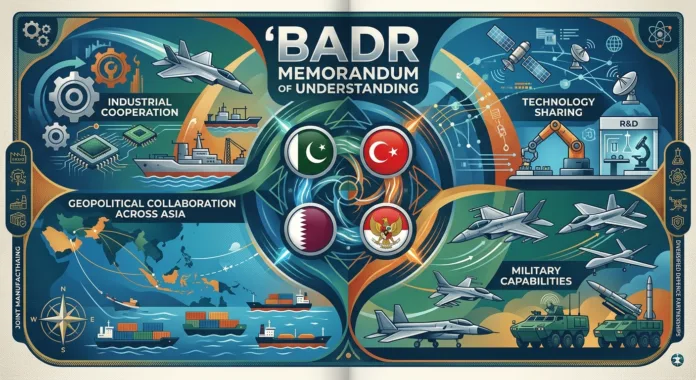
As global competition increases and traditional security partnerships evolve, countries are looking into other options to improve their defence capabilities. To reflect this changing landscape in the region, Pakistan, Türkiye, Qatar and Indonesia have signed the Badr Memorandum of Understanding on 21st October 2026 in Doha. This partnership looks to create a new network of defence cooperation between member countries, looking at industrial partnerships, technology sharing and building military capabilities.
This presents an important opportunity for Pakistan in regards to improving its defence diplomacy. Islamabad has had strong historic military and strategic partnerships with multiple Muslim majority states, notably Türkiye and Qatar. Now however, this partnership will see an increase in industrial and technological cooperation. With modern defence capabilities relying on research, high tech manufacturing, innovation and good supply chains.
Pakistan has much to offer this partnership. The country has experience in manufacturing aircraft, military equipment, naval capabilities and technical training. The defence infrastructure and skilled workforce available in Pakistan can aid in creating joint manufacturing opportunities with other members. This will allow Pakistan access to new investment opportunities due to increased integration of industries.
Türkiye will also play an important role in this partnership. Ankara has been a strong defence manufacturing country over the last decade. They have expanded into manufacturing drones, naval vessels, armoured vehicles and other defence technologies. They have also created partnerships in defence with many countries across Asia, Africa and the Middle East. This partnership can create new opportunities to collaborate and share knowledge.
The financial aspect from Qatar can provide a solid base. Developing a defence industry requires large amounts of investment. However, Qatar has existing investment partnerships with Türkiye’s defence industry. Indonesia also offers some further manufacturing capabilities and a large market in South East Asia. These factors mean there could be a strong partnership created between these countries.
There are already good relationships in place between these countries. Pakistan and Türkiye have already worked together on the MILGEM navy programme. Türkiye and Indonesia have worked on joint tank programmes. Qatar have invested in Türkiye’s defence industry. This partnership can link together these partnerships and encourage new projects to be undertaken.
This partnership is important as tensions continue to rise between the United States and Iran. This shows how vulnerable energy infrastructure, sea routes and economic infrastructure can be. If anything were to seriously disrupt this region it could impact the international energy markets and global trade. This means it is very important for Gulf countries to diversify their defence partnerships and improve their domestic capabilities.
This partnership will allow countries to work towards these goals without having to have the same foreign policy viewpoints. As it is not a mutual defence partnership, it will not require countries to go to war if another partner is attacked. This creates opportunities to work together on areas they already have shared interests in. This may be attractive to countries who want to have better security partnerships but still keep their strategic independence.
This should be seen in conjunction with the Makkah Joint Defence Agreement between Pakistan, Saudi Arabia and Türkiye. Whilst this is a collective defence agreement, the Badr partnership focuses on industrial partnerships. This shows how there are various ways to create security partnerships in the region. Whilst one can improve collective deterrence, another can improve technological capabilities.
This partnership will provide Pakistan with a wider diplomatic opportunity. It will improve their relationship with key partners in the region. It will provide an opportunity to work together outside of traditional military training and procurement. It will also provide an opportunity to link South Asian defence capabilities with Gulf investment and South East Asian manufacturing.
However, this will rely on how well the countries involved in the MoU implement the political aspects. There needs to be agreements in place to manufacture items together, share technology, research and investment. It will also be important to have clear priorities in place to ensure all countries benefit fairly.
Overall, this partnership presents an opportunity for Pakistan to help diversify the security environment in the region. Using Pakistan’s defence experience alongside Türkiye’s technological capabilities, Qatars investment capabilities and Indonesia’s manufacturing capabilities can create a sustainable partnership. Overall, it shows how influence can increasingly be gained through industrial capabilities, technological partnerships and economic interests rather than military alliances.
Bio
Umair Khan is an independent geopolitical analyst specializing in South Asian security, counterterrorism, Afghanistan, the Middle East and Indo-Pacific affairs. He contributes to international platforms and has published over 100 articles and op-eds.