✍ Bazgha Murtaza- Pakistan
Climate Change has emerged as one of the most defining challenges of the current times. It refers to the long-term fluctuations in meteorological conditions and weather patterns. According to the scientific assessments of Intergovernmental Panel on Climate Change (IPCC), anthropogenic activities such as burning of fossil fuels are the driving forces in shaping the planetary crisis. The projections of climatic patterns are now visible in rising temperatures, glacial melting, intense heat waves and worst torrential rains.
In real grounds, climate change entails the Tragedy of Commons. It refers to the idea that atmosphere is a global common wherein each state is acting in its self-interest that contributes to the collective depletion of a common good. However, the impacts of it are disproportionate with developing countries more vulnerable to it. In this context, Pakistan stands as the most climate vulnerable nation. Pakistan’s climate vulnerability is analyzed through a post-human approach by using anthropocene, capitalocene and colonialocene perspectives. In light of Pakistan’s growing climate crisis several policy measures have been suggested. These include just transition, opting for nature based solutions, strengthening climate governance frameworks and carbon trading. However, the challenges of corruption and climate injustice prevail. Therefore, the recommendations are enlisted for implementing strict enforcement measures and strengthening whistleblowing efforts against green washing.
Critical Analysis of Pakistan’s Climate Vulnerability
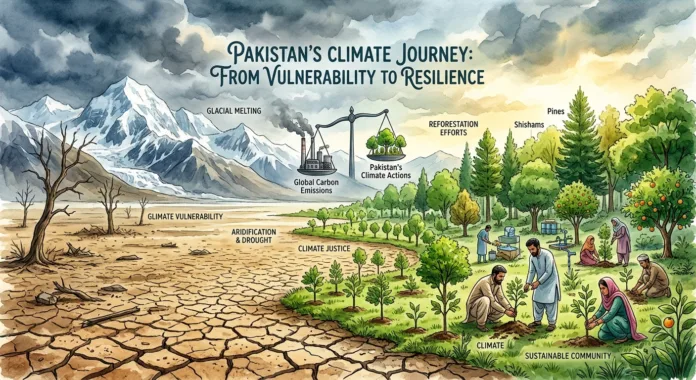
Pakistan’s contributions to global emissions are less than 1 percent. Despite this, it ranks among the top 10 highly vulnerable countries to climate change. In recent years, Pakistan has witnessed the increasing frequency of climate induced disasters reflected in the worst torrential rains, flash floods, and cloud bursting. The scale of this vulnerability has resulted in massive displacement, casualties, economic loss and infrastructural damage. Additionally, it has led to the climate conflict trap wherein environmental degradation leads toward agricultural decline thereby deepening socio-economic vulnerability and threatening the security of the state. Similarly, Pakistan has experienced drastic decline in agricultural productivity. Furthermore, the practice of flood brides became more common in some climate affected areas where minor girls are compelled into early marriages for the sake of survival. This demonstrates how ecological factors are impacting gender and social institutions.
In accordance with anthropocene perspective, Pakistan’s growing climate vulnerabilities are part of the human-driven global planetary crisis that poses an existential threat. Therefore, it promotes climate justice and advocates for a shared responsibility in mitigating the impacts of climatic change. On the contrary, Pakistan’s policy makers often view this narrative as insufficient because it neglects power asymmetries and structural inequalities in multilateral climate governance frameworks.
Capitalocene perspective, on the other hand, severely denounces the global capitalist economy for driving the climatic crisis. Capitalist mode of production relies aggressively on fossil fuels that contribute to carbon emissions and ecological collapse. For instance, President Trump has prioritized fossil fuel expansion under energy dominance doctrine to boost economic growth at the expense of ecology. Hence, this narrative associates Pakistan’s climate vulnerability with politically driven global capitalist supply chains. Pakistan’s situation is even worsened because of limited fiscal space and IMF-led austerities needed for climate change adaptation and mitigation.
Lastly, from the narrative of colonialocene Pakistan’s climate crisis dates back to its colonial legacy. Under British rule, the Indus Basin was modified through a vast network of embankments, canals, and ownership structures. This transformation significantly weakened the ecological balance of post-colonial state that now contributes to intense floods and water management problems. Concurrently, the Indus Water Treaty is also viewed as the colonial style of partitioning the Indus river without recognizing the local ecological realities. In the wake of Indo-Pak conflict 2025, the suspension of IWT by India highlights how the shared water resources can act as a strategic asset. Any illegitimate move can trigger a vicious cycle of conflict between belligerent parties.
Policy Measures:
To address the growing climate vulnerabilities, Pakistan should opt for several policy measures.
- Just Transition
It involves decarbonisation of economy by shifting from non-renewable energy sources to renewable energy sources. The Just Transition framework was opted by the Presidency of COP 30 to encourage states to limit global temperature by 1.5°C. In this account, climate reparations were proposed for developing countries to cultivate mitigation goals by modernizing heavy industries and power grids with clean energy sources.
- Climate Resilient Infrastructure
Pakistan should invest in building climate resilient infrastructure and direct air capture technology. The climate mitigation technologies significantly strengthen the country’s ability to tackle the risks of climate led disasters.
- Nature based solutions
Nature based solutions can effectively lead towards sustainable climate action. In Pakistan, Ten Billion Tree Tsunami Initiative is at the heart of it that aims to increase the green cover. Forests are considered as the natural sinks to CO2.
- Strengthening climate governance mechanisms
The need for inclusive climate action is required by strengthening local climate governance mechanisms. This can be achieved by coordinating climate adaptation and mitigation policies across different departments and government agencies.
- Carbon Trading
The article 6 of Paris Agreement permits countries for international carbon trading. Pakistan should meaningfully engaged in international carbon markets to trade it’s extra carbon credits. This would inturn generate climate finance to support mitigation and adaptation strategies.
Challenges and Recommendations
The most significant challenge within planet politics is the question of climate justice. According to the principle of Common But Differentiated Responsibility (CBDR), the global north should take the lead in addressing climate change by providing loss and damage compensations to developing nations. However, countries like Pakistan have limited bargaining power and unequal access to climate finance for post disaster recovery.
At the domestic level, Pakistan encounters institutional challenges such as weak enforcement mechanisms, and poor coordination. Lastly, the practices of corruption and integrity risks weaken its capacity to respond to climate change effectively. Therefore, it is recommended that;
- Pakistan should enact strict enforcement measures against the misuse of climate funds.
- Boosting whistleblowing efforts for reporting integrity risks at initial stages.
- Strengthening institutional and technical capabilities for enforcing climate action plans.
- Engaging in multilateral global climate governance platforms.
Effective implementation of policies is essential for yielding the pragmatic outcomes.
Conclusion
Pakistan has high climate vulnerability index in the South Asian region. Effectively promoting new policies and proposing sustainable solutions can build the country’s resilience against climate disasters. Additionally, Pakistan should actively seek technical knowledge, workable plan and assistance from developed countries in attaining carbon mitigating goals. Lastly, this eco-centric approach shed lights on planet politics concerning the planetary futures of globe.
✍ Bazgha Murtaza; MPhil Scholar at department of International Relations, Fatima Jinnah Women University and a young Associate Member at Sustainable Development Policy Institute (SDPI), Islamabad. Having completed internship at SDPI and subsequently being awarded one year Associate Membership.