✍ Aisha Kainat – Pakistan
Under the dawn of a new age, Eurasia has emerged as a new geographic entity. The region has now taken the place of the old-world order of the Cold War period. More connectivity and less conquest are witnessed in the region. A fundamental shift is taking place from military power to geo-economic integration of different regions.
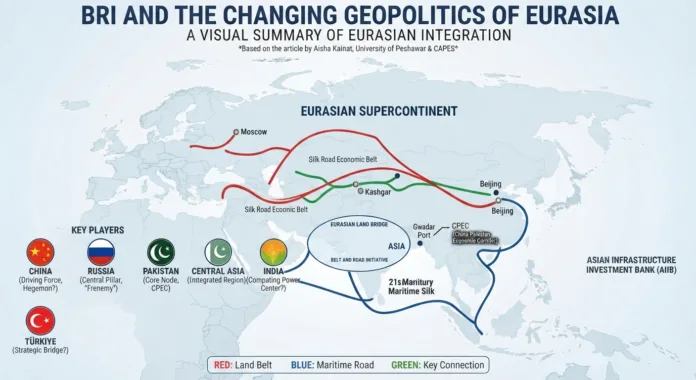
Viewed through the lens of inter-regional integration theory, inter-state collaboration and cooperation should occur in an appropriate manner. The Russian-Eurasian concept envisions multipolarity in the political sense, while the Chinese Belt and Road Initiative (BRI) aims at economic connectivity. They both represent a new paradigm of change in the geopolitical landscape. The BRI, as the strongest material expression of Eurasian integration, involves huge financial investment (about $4 trillion) in more than 70 countries, which does not entirely fit the Russian idea of Greater Eurasia.
Scholars define the “Eurasian order” as a huge expanse of land connecting Europe and Asia, where infrastructure, commercial relationships, and multiple power centers are growing. This concept envisions that “Greater Eurasia”, through the collaboration of Russia, China, India, Central Asia, and the countries of the region, will become one of the economic and political pillars of the new multipolar world. Bruno Maçães, in his concept of “supercontinent”, also argues that Eurasia has entered a new era of the formation of a continuum through infrastructure links. In contrast to Russian Eurasianism, which reflects the geopolitics of the 1920s romanticism and modern multi-polarity, Chinese Eurasianism is a civilizational and geopolitical concept, which is aimed at creating a haven for the development of non-Western geopolitical centers.
Being the mastermind and the driving force behind the BRI, China would evidently play the leading role in implementing the initiatives at all stages, from conception to implementation. It is not surprising that we can expect China to benefit from these giant economic connectivity projects at all levels. The initiative is deliberately intended to reshape the global political and economic order; the BRI covers more than seventy states. China’s trade with the participating countries in the Belt and Road Initiative (BRI) grew by 17.8% in January 2018. China’s BRI is undoubtedly the most significant geopolitical move in the 21st century so far, as it not only redefines the rules of the global game but also sets a new narrative for the regional order. Eurasian land bridge is not only the most extensive bridge within China’s ‘BELT’ in the BRI but also contributes to the emergence of multiple great powers from the Asian region. In addition, all the major powers in the world, like the USA, have already adjusted their policies and strategies based on connectivity and cooperation in response to the BRI.
With its vast scale and use of both hard (infrastructure) and soft (trade, agreements, cultural) resources, the BRI has created a complex web of interdependent economies through multiple financial tools, including the Asian Infrastructure Investment Bank (AIIB) and the $40 billion Silk Road Fund. Andrew Small argues that China’s BRI is intended to promote China’s strategic ambitions through economic means, such as OBOR connects the entire Eurasian Economic Union (EAEU) through extensive infrastructure, creating a foundation for the new Sino-centric world order (Small, 2018). Highlighting the significance of South Asia, especially for China’s BRI, he also notes that South Asia is the most promising region within Eurasia to achieve China’s goals, and the CPEC is the ultimate link between China and Pakistan (Small, 2018).
Within the framework of the Central Asia-South Asia Corridor and the Bangladesh-China-India-Myanmar (BCIM) Corridor, two other strategic connectivity projects, the CPEC emerges not only as a mega-project but also a “scenario changer” due to its economic and geopolitical significance for both China and Pakistan. Within the BRI framework, Pakistan plays a pivotal role as a core “node” in Eurasian connectivity. The CPEC, connecting western China to Gwadar’s deep-water port on the Arabian Sea, will provide the BRI with a critical link to South Asia and serve as an alternative route for China’s maritime trade. Shared destiny, harmony, and win-win cooperation are stated as the basis of the whole plan. The current economic strategy of China also reflects the ‘Chinese Dream’, with targets set for 2049 of being the world’s economic leader, by 2049 also fits into this narrative (Johnson, 2014).
While both countries share strategic interests, China and Russia have competing strategic concepts about the future of Eurasia. Moscow seeks a political order centered on sovereignty, regional balance, and resistance to Western unipolarity, often viewing its Eurasian Economic Union (EAEU) as a geostrategic bloc to preserve its sphere of influence, whereas Beijing prefers a less ideological, commerce-driven network where it serves as the central hub for a new era of globalization. Despite the differences, both countries cooperate closely; for example, in 2015, Russia and China agreed to connect the EAEU and the BRI. However, they do not share the same vision of Eurasian integration, and Moscow wants to avoid being subordinate to China’s growing economic and geopolitical influence.
The most significant geopolitical consequence of this new era is that Russia will return to being one of the critical powers in the world order through its role as the central pillar in Eurasian super connectivity. Perceiving Asia as the center of Russia’s geopolitical and geostrategic influence is no longer a novelty but a matter of time. Although Russia has developed its own geopolitical vision of integrating neighboring countries through the concept of the Eurasian Economic Union (EEU), so far, it has not achieved the same influence as the BRI. Given the circumstances, it seems quite viable that Russia will be able to influence the regional order in the future, using its position in China’s BRI, especially through the NELB.
The future of Eurasia will be built in the context of the “frenemy” (“friendly enemy”) policy pursued by both sides. In addition to being the material basis for the new Eurasian order, the BRI will most probably be a source of competition between these two powers in the long run. However, for now, the BRI will bring more economic benefits to regional countries like Pakistan if they manage to capitalize on the opportunities offered by this project. After all, we live in a world of realpolitik, where countries are guided only by their national interests and strive to maximize them. In the context of China’s BRI, which covers numerous countries rich in natural resources, Beijing finds itself in the position of a hegemon that is seeking to build a new world order around itself. Nevertheless, geography will continue to be the guiding principle of foreign policy for any country, as it has always been. Therefore, in this new era of Eurasian connectivity, when China is pursuing its ambitions to build a comprehensive regional and global alliance, other countries, including Russia, India, Iran, Turkey, and Japan, will seek to promote their geopolitical and geostrategic interests. The future of Eurasia depends on how China and Russia will handle their mutual concerns and whether they will move towards a common vision of Eurasian connectivity based on collaboration rather than competition over the heartland.
About the Author: I am Aisha Kainat, Political Science undergraduate at University of Peshawar, and Research intern at Consortium for Asia Pacific & Eurasian Studies (CAPES). My research interest include security studies, Geopolitics, governance, and human rights.