✍ By Iftikhar Gilani, Indian Journalist
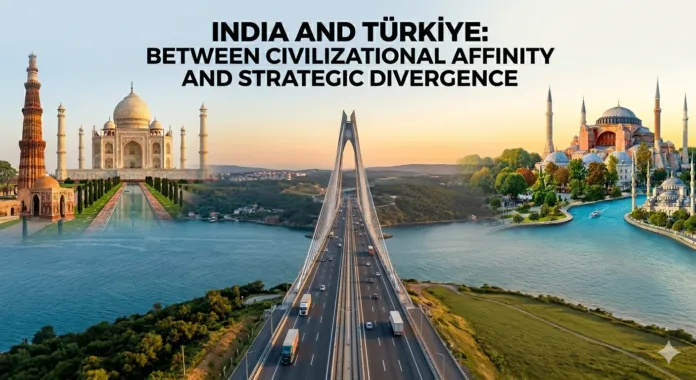
When Turkish Ambassador Şakir Özkan Torunlar was serving in New Delhi, he often remarked that centuries ago, only the Himalayas separated India and Türkiye. Today, the distance between the two countries can be covered in a six-hour flight. The observation captures both the historical intimacy and contemporary paradox of India-Türkiye relations.
Despite deep cultural links, shared historical memories and growing economic complementarities, political relations have frequently fallen short of their potential.
The story of India and Türkiye is much older than modern diplomacy. In fact, one could argue that the first major Turkic empire emerged in the Indian subcontinent with the establishment of the Delhi Sultanate by Qutb-ud-Din Aibak in 1206, more than a century before the Ottoman Empire consolidated itself in Bursa in 1326.
For centuries, the Indian subcontinent and Anatolia were connected through trade routes, intellectual exchanges, and migration. Historical studies suggest that commercial ties between India and Anatolia date back to the Bronze Age, expanding through caravan routes and maritime networks across the Persian Gulf and the Red Sea.
As Indian Ambassador to Türkiye Muktesh Pardeshi notes, Anatolia served as a bridge between Asia and Europe, redistributing Indian goods across Roman, Byzantine, and later Ottoman markets. The enduring legacy of this shared history continues to inform contemporary relations.
The relationship was not merely commercial. It was civilizational.
Even today, traces of this shared past survive in unexpected places. Nearly one million people of Turkic descent live across Sambhal, Moradabad, Rampur, Amroha, and Nagina in Uttar Pradesh. Sambhal is still popularly known as “Little Turkey.” Families proudly trace their ancestry to Turkic settlers who arrived centuries ago.
In Ladakh, part of the erstwhile state of Jammu and Kashmir, Turkish remained an important language of trade until the early twentieth century. Along the Leh-Yarkand trade route, Turkic merchants settled, married local women, and formed the Argon community, now fully integrated into Ladakhi society.
The symbols of solidarity during Türkiye’s struggle for independence are equally visible in India. Khilafat House in India’s commercial capital, Mumbai, remains a reminder of popular support for the Ottoman Caliphate and then Mustafa Kemal Atatürk’s War of Independence. Funds raised by Indian Muslims and nationalists helped support Türkiye during one of the most critical periods of its history.
Former Turkish Ambassador Torunlar has repeatedly noted that Mustafa Kemal Atatürk and his colleagues received strong support from the peoples of the Indian subcontinent during Türkiye’s War of Independence.
Likewise, Türkiye was among the first countries to recognize newly independent India. Torunlar also recalls that the relationship is reinforced by centuries of cultural interaction, with some linguists estimating that nearly 3,000 words share common roots or historical transmission across the two civilizations.
Lack of Strategic Partnership
Yet history alone has not been enough to create a strategic partnership.
Modern diplomatic relations began soon after India’s independence. The two countries exchanged ambassadors in 1948. A trade agreement followed in 1953, an expanded trade agreement in 1973, and a Joint Committee on Economic and Technical Cooperation in 1978. Business engagement also expanded with the creation of the FICCI-DEIK Joint Business Council in 1996. A Joint Study Group later examined the possibility of a bilateral Free Trade Agreement between 2010 and 2011, although the initiative never materialized. A Joint Economic Commission was set up, but it has not met since 2014.
Türkiye became a key member of NATO and aligned itself closely with the Western bloc. India, meanwhile, championed non-alignment while maintaining close ties with the Soviet Union. Pakistan’s strategic partnership with Türkiye and India’s proximity to Moscow often complicate bilateral perceptions.
The end of the Cold War created opportunities for a reset, but old habits persisted.
According to Dr. Omair Anas, Assistant Professor in the Department of International Relations at Ankara Yildirim Beyazit University, sections in both countries continue to view each other through Cold War lenses.
At a recent webinar, he noted that in Türkiye, India was long viewed through the prism of Pakistan. In India, Türkiye has frequently been viewed through the lens of Greece, Cyprus, and, more recently, Ankara’s position on Kashmir. This historical baggage continues to shape contemporary relations.
Professor Mehmet Özkan of Türkiye’s National Defence University argues that India and Türkiye are not ordinary bilateral partners but what he describes as “systemic relationships.” Developments in one country have implications extending across Central Asia, South Asia, West Asia, and beyond.
Yet, paradoxically, he notes that India is missing from Türkiye’s Asia policy while Türkiye remains missing from India’s Middle East or West Asia strategy. These, he argues, are not minor omissions but key pieces of a larger geopolitical puzzle.
The most visible effort to redefine the relationship came during President Recep Tayyip Erdoğan’s state visit to India in April 2017.
Erdoğan arrived with a delegation of approximately 400 ministers, politicians, business leaders, and officials. Prime Minister Narendra Modi personally attended the Türkiye-India Business Forum, a rare gesture reflecting the significance attached to the relationship.
Notably, Erdoğan travelled directly from Türkiye to India and returned directly to Türkiye, without combining the visit with any other regional destination. The visit opened a new chapter in bilateral ties and generated considerable momentum in economic and people-to-people engagement.
What is often forgotten is the context in which the visit occurred.
Only days before Erdoğan’s arrival, then Indian Vice President Hamid Ansari visited Armenia and paid tribute at the Tsitsernakaberd Memorial, one of the most sensitive issues in Turkish foreign policy.
Turkish concerns were reportedly conveyed privately, but Ankara deliberately chose not to make the issue public and proceeded with the visit as planned. For many Turkish diplomats, the episode remains an example of how strategic relationships should be managed: disagreements acknowledged but not allowed to overshadow broader cooperation.
The results were immediate. Tourism expanded rapidly. The number of Indians visiting Türkiye increased from approximately 86,000 to over 236,000 within less than three years. Turkish companies showed growing interest in India’s Smart Cities Mission and Make in India initiative. Business contacts multiplied, and optimism grew on both sides.
Yet that momentum proved difficult to sustain. The most significant obstacle remains political trust.
India remains highly sensitive to Turkish statements on Kashmir. Former Indian Ambassador to Türkiye Sanjay Panda, referring to Ankara’s position on Kashmir, observed that if Türkiye’s narrative on Kashmir makes it difficult for India to conduct relations as “business as usual.” He cited President Erdoğan’s characterization of Operation Sindoor as “unprovoked aggression” as an example of rhetoric that generated concerns in New Delhi.
From the Turkish perspective, however, the debate increasingly revolves around reciprocity.
Turkish analysts point to President Erdoğan’s decision not to mention Kashmir during his 2024 address to the United Nations General Assembly. The omission was widely noticed because Kashmir had featured prominently in previous Turkish interventions. Yet many Turkish observers argue that the gesture failed to produce any meaningful political opening from India. The perception that flexibility is not always reciprocated has become increasingly common among Turkish diplomats and analysts.
Prisoners of Emotional Politics
Professor Özkan argues that both countries are often prisoners of emotional politics. While recognizing the importance of political disagreements, he insists that India and Türkiye have no direct conflicts, no territorial disputes, and no inherent strategic rivalry.
“One of the biggest problems between Türkiye and India,” he observed, “is that we have not been able to separate economic relations from political relations.” Businesses frequently find ways to cooperate despite political disagreements, but crises repeatedly disrupt economic momentum.
The economic relationship perhaps offers the strongest argument for a reset.
According to the report Increasing Economic Synergies between India and Türkiye, published by TEPAV with support from the Indian Embassy in Ankara, bilateral trade remained below half a billion dollars until the 1990s. It crossed the one-billion-dollar mark only in 2004, reached $10 billion in 2021, and peaked at approximately $14 billion in 2022-23 before moderating to around $10.4 billion in 2023-24.
Yet both countries remain marginal trading partners for one another. India’s share in Türkiye’s imports stands at only 2.3 percent, while Türkiye’s share in India’s imports has remained below one percent for decades.
Torunlar frequently highlights this contradiction. During his tenure in India, bilateral trade rose from approximately $6 billion to nearly $10 billion before the pandemic. Yet, as he points out, these figures remain remarkably small for two G20 economies. One is now the world’s fourth-largest economy. The other is among Europe’s most significant manufacturing powers. A trade volume of less than $10 billion hardly reflects the true potential of either economy.
The encouraging reality is that the two economies increasingly complement rather than compete with one another.
India’s transformation since the liberalization reforms of 1991 has been driven by a globally connected diaspora, a strong digital ecosystem, expanding manufacturing capabilities, and internationally competitive sectors such as pharmaceuticals, chemicals, and information technology.
According to the TEPAV study, India’s high-technology exports reached approximately $84.5 billion in 2024, with pharmaceuticals accounting for nearly one-third of those exports.
Türkiye’s trajectory has been different but equally significant. Economic reforms initiated under Turgut Özal in the 1980s, followed by post-2001 restructuring and integration with European value chains through the Customs Union, transformed Türkiye into a major exporter of medium-technology products, particularly automobiles, industrial machinery, and engineering goods. Today, Türkiye serves as a critical manufacturing, logistics, and services hub linking Europe, Asia, and the Middle East.
The TEPAV report concludes that these complementary strengths create a strong rationale for cooperation. Electronics, pharmaceuticals, chemicals, machinery, renewable energy, infrastructure, healthcare, information technology, startups, food processing, and advanced manufacturing all offer substantial opportunities.
The report also proposes collaboration in value chains and joint access to third-country markets, particularly the European Union and the United States. Ambassador Pardeshi argues that cooperation should focus on high value-added trade, technology collaboration and joint product development rather than traditional commodity exchange.
Geopolitical Environment
The geopolitical environment is also creating new incentives for cooperation.
The wars in Ukraine and Gaza, together with instability involving Iran, have transformed the regional landscape. Both India and Türkiye depend heavily on imported energy. Both support regional stability. Both oppose the fragmentation of states such as Iran, Iraq, and Syria.
Ambassador Panda argued that instability in Iran directly affects India’s long-term interests, particularly in energy security and connectivity. Torunlar similarly warned that neither India nor Türkiye would benefit from the disintegration of regional states because the consequences would be unpredictable and potentially destabilizing.
Dr. Omair Anas likewise observed that the security architecture of both countries would be adversely affected by prolonged instability in Iran. On many major regional issues, including Ukraine, Gaza, and Iran, the differences between India and Türkiye are often smaller than commonly assumed.
Yet one of the weakest links in the relationship remains people-to-people engagement.
While tourism expanded significantly during the late 2010s, academic exchanges, think tank cooperation, and civil society dialogue remain underdeveloped. The interaction between Indian and Turkish intellectuals, media professionals, and civil society organizations remains surprisingly limited.
There is a need for intellectuals and civil society to take the lead in explaining each country directly to the other, rather than allowing third parties to shape perceptions. The absence of sustained dialogue contributes directly to stereotypes and misunderstandings.
The future of India-Türkiye relations will ultimately depend on whether both sides can compartmentalize political disagreements and pursue practical cooperation.
Business communities should be encouraged to lead. Trade and investment should not become casualties of every diplomatic disagreement. Connectivity should be expanded through tourism, logistics, and digital partnerships. Strategic dialogue on West Asia, Central Asia, and emerging global challenges should be institutionalized. Universities, think tanks, and media organizations should establish regular exchange programmes to reduce mutual misconceptions.
India and Türkiye are not natural rivals. They are emerging powers confronting similar challenges: energy security, technological transformation, supply-chain disruptions, and regional instability.
History has provided them with a remarkable foundation of cultural affinity and mutual goodwill. Economics offers compelling reasons for deeper cooperation. Geopolitics increasingly demands coordination among influential middle powers capable of contributing to regional stability.
Yet the relationship continues to be constrained by political mistrust and inherited narratives.
The challenge is not the absence of opportunities. The challenge is the absence of a sufficiently ambitious vision.
If Ankara and New Delhi can move beyond episodic disagreements and embrace a pragmatic framework centered on trade, technology, connectivity, and strategic dialogue, the relationship could emerge as one of the most consequential partnerships linking South Asia, West Asia, and Europe.
The civilizational bridge already exists. The task now is to build a strategic one.
***Iftikhar Gilani is an Indian journalist, based in Ankara
Sources used: the webinar transcript on India–Türkiye relations and the TEPAV/Embassy of India report Increasing Economic Synergies between India and Türkiye .