✍ Dr. Zeeshan Malik, Faculty of Social Sciences OSTIM Teknik University Ankara
As the Gulf Cooperation Council (GCC) tightens financial compliance after recent regional tensions, South Asian businesses are adapting to a new commercial reality. The resulting shift in capital and trade patterns may create fresh opportunities for Türkiye to emerge as a trusted regional investment and logistics hub.
For decades, the GCC represented one of the world’s most dynamic commercial crossroads. The United Arab Emirates, particularly Dubai, became the preferred gateway for South Asian entrepreneurs seeking access to the Middle East, Africa and Europe. Flexible regulations, world-class logistics, political stability and efficient financial services transformed the Gulf into the preferred destination for businesses from India, Pakistan and beyond.
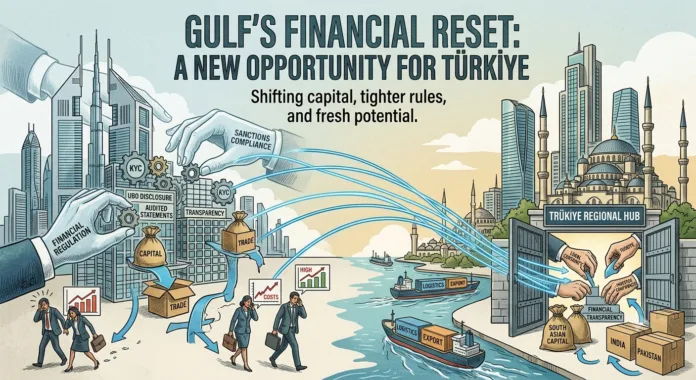
Yet the Gulf is entering a new economic era. The recent regional conflict, in which several Gulf states themselves became potential targets amid escalating hostilities, has reinforced an emerging trend that was already underway: a comprehensive tightening of financial regulation and sanctions compliance. The objective is clear. Gulf governments want to strengthen the credibility of their financial systems, reassure international investors and eliminate vulnerabilities that could expose them to geopolitical or regulatory risks.
The transformation goes well beyond routine banking reforms. It represents a structural realignment of how capital enters, circulates and leaves the Gulf.
For years, international regulators, financial watchdogs and sanctions-monitoring agencies have pointed to the existence of complex intermediary networks that facilitated transactions involving high-risk jurisdictions. These arrangements often relied on front companies, layered ownership structures, informal money-transfer mechanisms and opaque settlement channels that operated outside conventional regulatory oversight.
Today, Gulf authorities are systematically dismantling many of these practices.
Banks are conducting far more rigorous Know Your Customer (KYC) procedures. Ultimate Beneficial Ownership (UBO) disclosures are being scrutinized with unprecedented attention. Source-of-funds documentation, audited financial statements and detailed ownership records have become standard requirements rather than exceptional requests. Businesses unable to provide satisfactory documentation increasingly face delays or temporary restrictions while compliance reviews are completed.
This transition reflects not only domestic policy choices but also broader international expectations. As Gulf sovereign wealth funds expand globally and multinational corporations deepen their investments in the region, maintaining the confidence of international financial markets has become a strategic priority. No government seeking to position itself as a global financial centre can afford the perception that its banking system facilitates sanctions evasion or opaque financial activity.
The immediate consequences, however, are being felt far beyond the intended targets of these reforms.
Among those most affected are thousands of small and medium-sized enterprises operated by Indian and Pakistani entrepreneurs. For decades these businesses have formed an essential part of the Gulf’s commercial ecosystem, particularly in wholesale trade, logistics, construction support services and re-export activities. Many grew through relationship-based business models that evolved during a period when commercial flexibility often outweighed regulatory formalities.
That environment is changing rapidly.
The difficulties confronting many South Asian businesses should not be viewed as evidence of discrimination. Available evidence suggests that regulatory scrutiny is being applied primarily to business structures and transaction patterns rather than nationality. Nevertheless, firms accustomed to informal accounting practices, undocumented ownership arrangements or traditional banking relationships now face significant adaptation costs.
For many family-owned businesses, the new compliance architecture requires investments in professional accounting, legal advisory services and corporate governance that were previously considered unnecessary. Compliance has effectively become a new cost of doing business.
The recent conflict has added another important dimension to this transition. Although Gulf governments demonstrated considerable resilience during the crisis, the episode reminded international investors that geopolitical risks can affect even the region’s most established financial centres. For many South Asian investors who have historically regarded the Gulf as the safest destination for regional capital, diversification is becoming an increasingly attractive strategy.
This changing landscape presents an opportunity for Türkiye.
Over the past two decades, Türkiye has steadily strengthened its position as a regional manufacturing, logistics and financial hub connecting Europe, Asia, the Caucasus and the Middle East. Its extensive transportation infrastructure diversified industrial base and well-developed banking sector already make it an important destination for international investment. Unlike jurisdictions that primarily function as transit centres, Türkiye offers investors access to a large domestic market alongside export opportunities into multiple regions.
As Gulf financial systems become more compliance-intensive and geopolitical uncertainty encourages greater diversification, some South Asian capital that has traditionally been parked in Gulf financial centres may increasingly look toward alternative destinations. Türkiye is well positioned to benefit from this trend, provided it continues strengthening legal certainty, investor confidence and financial transparency.
This should not be interpreted as a zero-sum competition between Türkiye and the Gulf. The GCC will remain one of the world’s leading commercial and investment destinations. Rather, evolving regional dynamics are likely to produce a more diversified geography of capital, where investors seek complementary rather than exclusive financial centres.
For Türkiye, this presents an opportunity to deepen partnerships with both Gulf economies and South Asian businesses. Turkish banks, logistics companies, industrial zones and technology parks could become increasingly attractive platforms for companies seeking to diversify their regional presence while maintaining strong commercial links with the GCC.
Ultimately, the Gulf’s transformation reflects a broader shift in the global economy. Competitive advantage is no longer measured solely by speed, tax incentives or commercial flexibility. Increasingly, it is defined by transparency, regulatory credibility and institutional resilience.
The GCC’s financial reset is therefore more than a compliance story. It is reshaping regional trade, investment flows and business strategies across the Middle East and South Asia. Those businesses that adapt to the new rules will continue to prosper. Those countries that position themselves as trusted, transparent and strategically connected investment destinations will attract the next wave of regional capital.
For Türkiye, the moment presents not merely a challenge to observe, but an opportunity to seize.