✍ By Iftikhar Gilani – Indian Journalist
Abstract
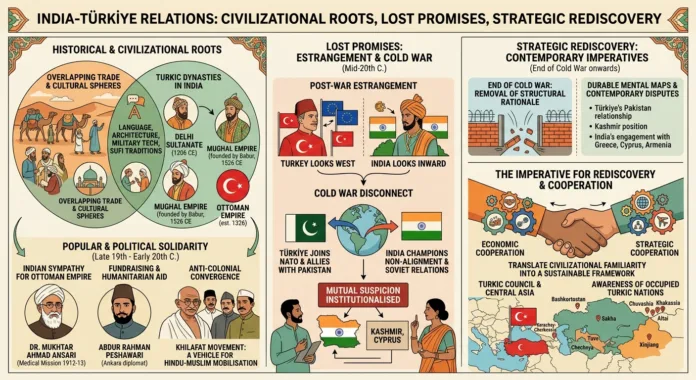
Relations between India and Türkiye are commonly interpreted through the contemporary disputes that periodically divide New Delhi and Ankara, particularly Türkiye’s strategic relationship with Pakistan, its position on Jammu and Kashmir, and India’s growing engagement with Greece, Cyprus and Armenia.
While these issues constitute important elements of present-day foreign policy, viewing India-Türkiye relations primarily through them obscures a much longer and considerably richer historical relationship.
For several centuries, the Indian subcontinent, Central Asia and Anatolia formed parts of overlapping commercial, political, intellectual and cultural worlds. Turkic dynasties shaped important periods of Indian history; merchants travelled through Central Asian and Himalayan routes connecting India with the wider Turkic world; Indian commodities circulated through Ottoman markets; and languages, literature, architecture, military technology and Sufi traditions travelled between societies.
The Mughal or Baburid Empire, founded by Zahir-ud-Din Muhammad Babur in India in 1526, remains part of Türkiye’s wider understanding of Turkic history, a connection visibly acknowledged in contemporary Turkish scholarship and ceremonial representation.
Although Qutb-ud-din Aibak had founded the first Turkic empire as the Delhi Sultanate in 1206 CE, much before the Ottomans established their empire in Bursa in 1326.
The relationship acquired an extraordinary popular and political dimension during the late nineteenth and early twentieth centuries. Indian sympathy for the Ottoman Empire during the Balkan Wars led to fundraising, humanitarian assistance and organised medical missions. It was actually anti-colonial sentiments in India that converged into support against Türkiye’s dismemberment and for its freedom struggle.
The majority of Turks also want to remember this support with this formulation rather than support for the continuation of the decaying Khilafat system.
Dr. Mukhtar Ahmad Ansari led a major Indian medical mission to Ottoman Türkiye in 1912-13. Abdur Rahman Samdani alias Peshawari, a young student connected ancestrally with Kashmir and studying at Aligarh, travelled with this movement of solidarity and subsequently devoted much of his short life to Türkiye, serving in military campaigns, joining the Turkish national struggle, working with the newly established Anadolu Agency and serving the Ankara government diplomatically.
Interestingly, Samdani alias Peshawri is the elder brother of Mohammad Yunus Khan (1916–2001), a prominent Indian diplomat and close confidant of the Nehru-Gandhi family. So he is also linked to the family of Khan Abdul Gaffar Khan.
Most significantly, the fate of Türkiye became deeply intertwined with India’s own struggle against British colonial rule. Mahatma Gandhi’s support for the Turkish cause and his alliance with the Khilafat leadership helped transform what had begun as concern over the Ottoman settlement into one of the first genuinely mass movements of Indian anti-colonial politics. The Turkish question became a vehicle for Hindu-Muslim political mobilisation at a crucial stage of India’s national movement.
The central argument of this paper is that the subsequent estrangement between India and Türkiye was therefore neither historically natural nor civilizationally predetermined. Turkiye after becoming Republic choose to look towards the West and abandoned its connections to the East. India preferred to look inwards after its independence.
A deeper strategic disconnect developed during the Cold War, when Türkiye joined NATO and entered security arrangements with Pakistan while India championed non-alignment and developed an increasingly close relationship with the Soviet Union. Kashmir, Cyprus and competing regional alignments subsequently institutionalised mutual suspicion.
The end of the Cold War removed much of the structural rationale for this estrangement, yet the mental maps created during that period have proved remarkably durable. The task before contemporary India and Türkiye is therefore not to manufacture a relationship where none existed, but to rediscover a neglected one and translate civilizational familiarity into a sustainable framework of economic, diplomatic and strategic cooperation. It has become more necessary now as Turkiye plays a lead role in the Turkic Council and Central Asian countries treat it as their lead guide. It must also be borne in mind that out of 22 Arab nations, only Palestine is occupied, but most of the Turkic nations remain occupied, like Bashkortostan, Sakha (Yakutia), Chuvashia, Tuva, Khakassia, Altai, and Karachay-Cherkessia, Dagestan and Chechnya, etc., under Russia and Xinjiang under China.
👇👇👇