✍ Aiman Mushtaq – Pakistan
Presidents, prime ministers, and formal gatherings are what usually come to mind when we hear the word diplomacy. But diplomacy is not confined to conference rooms. It lives in everyday moments. A Chinese child enjoying Pakistani mangoes in Beijing, or a Pakistani family tasting Karachi-style biryani in Chengdu, is practicing diplomacy. So is seeing Chinese calligraphy in Islamabad, or learning Mandarin at the University of Sargodha. These small acts do what treaties alone cannot: they bring people closer.
Pakistan and China have proudly called each other “iron brothers” for over 70 years. Yet, for most of that time, governments have shaped the relationship more than ordinary people. China-Pakistan Economic Corridor (CPEC) has undoubtedly improved trade, connectivity, and infrastructure. These are some of the vital achievements. But roads alone do not define the sustained friendship between the two.
Real friendship between countries begins with people. That is where cultural diplomacy truly shines. Learning about each other’s language, customs, history, and everyday life helps us understand one another better. This is how genuine friendship between nations is actually built. Activities like student exchanges, cultural festivals, language learning, movies, music, and cuisine may seem simple, but are crucial in building trust between societies.
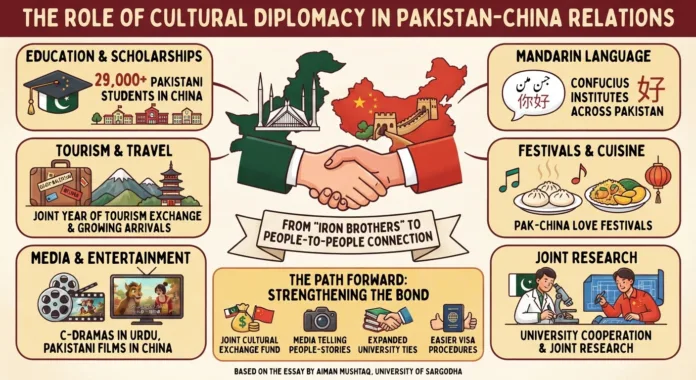
Culture matters just as much as trade or defense. If we want the “All-Weather Strategic Cooperative Partnership” to last for decades, we need people to actually understand each other. Education is one of the clearest examples of cultural diplomacy between Pakistan and China. The China Scholarship Council continues to offer scholarships to Pakistani students, helping thousands continue their studies there. For example, in August 2023, HEC sent 50 Pakistani students to China under the Chinese Government Scholarship Programme. As of December 2025, nearly 29,000 Pakistani students were studying at Chinese universities, with around 6,000 receiving scholarships. They study subjects including engineering, computer science, AI, business, medicine, and international relations at leading institutions such as Tsinghua University, Peking University, Fudan University, Shanghai Jiao Tong University, and Wuhan University. China is therefore one of the most preferred destinations for Pakistani students seeking higher education abroad. These students do more than earn degrees. They experience Chinese life and culture firsthand.
Language learning has played a similar role. Mandarin classes have grown rapidly across Pakistan in the past few years. China now runs Confucius Institutes at five universities in Sargodha, Lahore, Karachi, Faisalabad, and Islamabad. Pakistani students are learning Mandarin through these institutes. They are not just learning a new language. They are stepping into another Culture.
The lessons are not limited to the classroom. Tourism is another way people from both countries get to know each other. We build mutual trust and understanding through travel, dining together, and visiting each other’s cities and historical sites, something no diplomatic agreement alone can achieve. Chinese tourists increasingly travel to Pakistan to explore places such as Takht-i-Bahi, Taxila, Skardu, Hunza, and Gilgit-Baltistan. Pakistan recorded 64,460 arrivals from mainland China in 2024, up from 49,519 in 2023, showing growing people-to-people contact through tourism. At the same time, many Pakistanis travel to China to visit the Great Wall, the Forbidden City, Shanghai, and Beijing. Pakistan and China have also promoted bilateral tourism, with 2023 designated as the China-Pakistan Year of Tourism Exchange to increase tourist flows and strengthen people-to-people contact.
Festivals also make the relationship personal. Food, music, traditional dress, and cultural performances give people a chance to experience each other’s traditions. In Pakistan, Chinese chefs, artists, and musicians share their culture with local audiences. In Pakistan, Chinese culture is shared through food, music, and performances. For example, the Pak-China Love Festival 2025 in Lahore featured Pakistani and Chinese food, handicrafts, cultural performances, and music. In China, Pakistan introduces mangoes, biryani, chapli kebabs, gol gappas, folk music, Sufi traditions, and handicrafts. In 2022, the Pakistan Food and Cultural Festival in Langfang, China showcased Pakistani cuisine, handicrafts, and cultural performances, giving Chinese audiences an opportunity to experience Pakistani culture. These events might seem small, but people remember them.
Television and online platforms have brought Pakistani and Chinese culture into our homes, making us feel less distant. In 2017, Pakistan Television aired its first Urdu-dubbed Chinese drama, Beijing Youth, a 36-episode series translated by China Radio International and dubbed into Urdu in Karachi. Since then, C-dramas have attracted growing interest among the Pakistani audience, especially the youth, as Urdu-translated C-dramas have become available through online platforms. This allows youth to engage with Chinese culture and lifestyle without the language barrier. Likewise, Pakistani dramas are now shown on Chinese platforms with Mandarin subtitles. The Donkey King, one of Pakistan’s most successful animated films, received a wide theatrical release in Chinese cinemas on November 19, 2021, opening doors for more Pakistani films in the Chinese market. More recently, The Legend of Maula Jatt premiered in Beijing and opened in Chinese cinemas on May 21, 2026, marking a milestone in cultural exchange between Pakistan and China.
Sometimes a television drama leaves a stronger impression than a formal memorandum of understanding signed by officials. On the contrary, some argue that Pakistan cannot afford cultural diplomacy now. With unemployment, inflation, and rising debt, they say we should focus only on economics. Focusing on cultural initiatives will slow economic projects. Their concern is understandable. But culture and economics are not enemies. Economic projects become more meaningful when people trust one another. We don’t have to choose between roads and relationships. We need both.
If we want their friendship to last, we must back our words with action. First, establish a jointly funded Pakistan-China Cultural Exchange Fund to support universities, scholarships, and cultural programs. Second, our media must tell more stories of students, teachers, tourists, and families instead of focusing only on politics and business. Third, universities should expand joint research and scholarships. Finally, visa procedures must be made easier for students and tourists.
Pakistan-China relations have always been built on strong political and economic ties, but their future depends on something deeper: the connection between their people. From students and tourists to films, food, festivals, and language, cultural diplomacy creates understanding that cannot be achieved through agreements alone. CPEC can build roads and strengthen economies, but cultural exchange builds trust and friendship. If Pakistan and China invest not only in infrastructure but also in people-to-people connections, the bond between the two countries can become stronger, more meaningful, and more sustainable for generations to come. True friendship between nations is not only signed in documents; it is experienced by their people.
About the Author:
I am Aiman Mushtaq, a BS International Relations student at University of Sargodha, with an interest in geopolitics, regional affairs, and international security. I am currently working as an intern at the Consortium for Asia Pacific and Eurasian Studies (CAPES), where I am developing my research and analytical skills. My interests include foreign policy, regional cooperation, and contemporary international affairs.