✍ Bazgha Murtaza – Pakistan
The global race for critical minerals is significantly shaping geo-economic relations. Critical minerals are regarded as the new oil of current century. Therefore, states are no longer focusing on buyers and sellers rather they are looking for reliable partners across the mineral value chains. This, inturn creates an opportunity for the resource rich countries like Australia and Pakistan to build the pragmatic partnership essential to strategic minerals, foreign direct investment, R&D and technical mining cooperation.
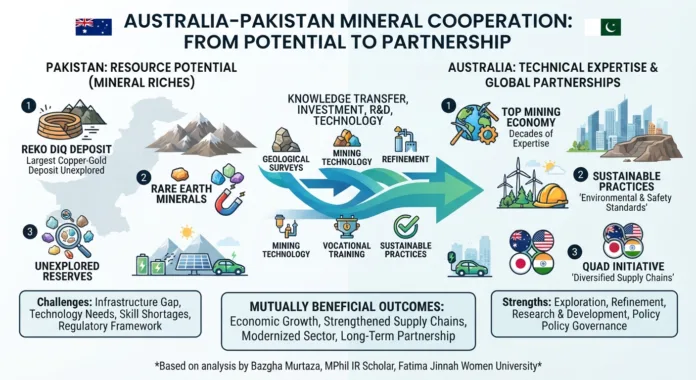
Critical Minerals are essential geological ores including lithium, copper and rare earth elements that are central to electric vehicles, sophisticated weapons, low carbon technologies and advanced semiconductor manufacturing. Australia has one of the world’s top mining economies with robust expertise in exploration, refinement, sustainable mining practices alongside Research and Development. Pakistan, on the other hand, holds a significant unexplored mineral resource, including the world’s largest Reko Diq copper-gold deposit and large reserves of heavy rare earth minerals. Altogether, these strengths can positively contribute towards mutually beneficial and sustainable partnership.
In the contemporary context both countries are heading in the same direction. As of January 2026, Australian High Commissioner Timothy Kane and Pakistan’s Petroleum Minister Ali Pervaiz Malik are agreed to enhance cooperation in mineral sector. Additionally, Australian companies have already been involved in the Reko Diq mining project. Pakistan has proposed an intergovernmental agreement to boost bilateral cooperation to facilitate further investment.
The background is equally important. Australia has considered critical minerals a central pillar of its strategic and economic policy. Through the QUAD Critical Mineral Supply Chains Initiative Australia has expanded its mineral partnerships with like-minded allies such as the India, Japan and the United States to build a diversified and secure supply chains. These set of agreements encourage technological transfer, transnational investments, mineral refinement and workforce development rather than focusing solely on resource extraction. This model could help Pakistan in developing and modernizing its own mining sector.
However, Pakistan’s critical mineral sector faces significant challenges. Inadequate mining and refinement infrastructure, technological gap, lack of skilled workforce, limited Research and Development, regulatory uncertainty and limited geological surveys persistently slow down investments. In contrary, Australia holds a decade long expertise in mineral extraction, refinement, environmental regulations, vocational training and occupational safety. Therefore, robust cooperation in these strategic areas would help Pakistan to improve governance while also making its mineral sector more attractive to global investors.
Concurrently, success doesn’t rely solely by the number of mining initiatives. Sustainable cooperation in areas such as research partnerships, digital geological mapping, vocational training programmes for engineers and geologists, environmental regulations is the need of the hour. These initiatives would not only boost local capacity but also ensure that mineral wealth contributes to long term economic growth.
Against this backdrop, Pak-Australia mineral cooperation presents more than an investment opportunity. It is a way to connect Pakistan’s resource potential with Australia’s technical expertise. All it requires is transparent policies, clear governance framework and sustainable commitments. Resultantly, this mining partnership would enhance economic ties, strengthen mineral supply chains and deliver benefits to host countries. In today’s world where critical minerals are as important as oil previously was, therefore, robust cooperation today can build a stronger economic tie for the future.
Author: Bazgha Murtaza is an MPhil IR Scholar at Fatima Jinnah Women University and a research intern at CAPES.