✍ Dr Shujaat Ali Quadri (The Author is the Deputy Director of the Indo Islamic Heritage Centre,India)
The international order is undergoing a profound transformation. The era of unipolarity is steadily giving way to a more complex multipolar world, where emerging powers are seeking greater strategic autonomy, diversified partnerships, and a stronger voice in global governance. In this evolving geopolitical landscape, India and Türkiye two ancient civilizations, influential regional powers, and members of the G20 find themselves confronting many of the same global challenges, even as they differ on certain geopolitical questions. Over the past decade, bilateral relations have experienced moments of diplomatic unease, particularly over Kashmir, Pakistan, and differing approaches to developments in West Asia. While these differences are real and cannot be ignored, they should not obscure a broader strategic reality: India and Türkiye possess significant converging interests that could form the basis of a pragmatic, forward-looking partnership.
History reminds us that enduring international partnerships are rarely built on complete political agreement. Instead, they emerge from shared interests, economic complementarities, and a recognition that cooperation often serves national interests better than confrontation. In that sense, India and Türkiye stand at an important strategic crossroads.
Civilizational Powers in a Changing World
India and Türkiye are among the world’s oldest civilizations, each endowed with a rich historical legacy and a distinctive geopolitical identity. Today, both aspire to play a larger role in shaping international affairs rather than merely adapting to decisions taken elsewhere. India’s rise as one of the world’s fastest-growing major economies and Türkiye’s strategic location at the crossroads of Europe, Asia, and the Middle East have significantly enhanced their global importance.
Although their foreign policy traditions differ, both countries increasingly value strategic autonomy. India has pursued a policy of multi-alignment, maintaining productive ties across competing power centres without becoming part of any formal military bloc. Türkiye, while remaining a NATO member, has also demonstrated an increasing willingness to pursue an independent foreign policy, balancing relations with Europe, Russia, Central Asia, and the Middle East according to its own national interests. This shared preference for independent decision-making provides a useful foundation for constructive engagement despite periodic diplomatic disagreements.
Managing Differences Through Pragmatism
Any realistic assessment of India Türkiye relations must acknowledge the areas of divergence.
Türkiye has repeatedly expressed support for Pakistan’s position on Kashmir at international forums, a stance that India considers interference in its internal affairs. The two countries have also adopted different positions on several developments in West Asia and regional security issues. However, mature diplomacy does not require complete agreement. Instead, it requires the ability to separate areas of disagreement from areas where cooperation remains both possible and beneficial.
Modern international relations provide numerous examples of countries maintaining robust economic and strategic partnerships despite political differences. India enjoys close ties with several nations whose views diverge from its own on important global issues. Likewise, Türkiye has successfully maintained productive relations with countries that do not always share Ankara’s foreign policy outlook. Rather than allowing one contentious issue to define the entire bilateral relationship, New Delhi and Ankara should adopt a compartmentalized approach continuing dialogue on political differences while expanding cooperation in trade, technology, education, tourism, and investment.
Unlocking Economic Potential
Perhaps the most underdeveloped aspect of India Türkiye relations is economic cooperation. Considering that both are G20 economies with a combined population of over 1.5 billion people, bilateral trade remains far below its true potential.
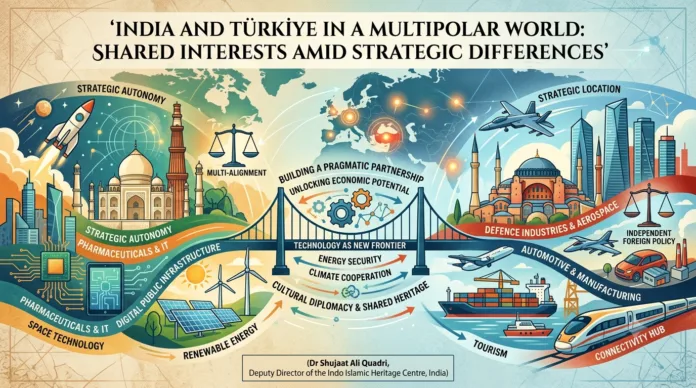
The complementarities are evident. India has developed significant strengths in pharmaceuticals, information technology, digital public infrastructure, renewable energy, advanced manufacturing, and space technology. Türkiye, meanwhile, has established internationally competitive capabilities in construction, infrastructure development, automotive manufacturing, textiles, tourism, and defence industries. As global supply chains undergo restructuring, both countries have an opportunity to deepen commercial engagement.
For Indian manufacturers seeking access to European, Central Asian, and North African markets, Türkiye offers an attractive logistical gateway. Likewise, Turkish companies looking to expand into one of the world’s fastest-growing consumer markets would find India an increasingly important destination. Greater investment flows, stronger banking cooperation, business-to-business partnerships, and enhanced connectivity could substantially increase bilateral trade while reducing economic vulnerabilities.
Connectivity in an Era of New Trade Routes
Geography continues to shape global commerce. Türkiye occupies one of the world’s most strategic locations, connecting Europe, the Mediterranean, the Black Sea, the Caucasus, and West Asia. India, meanwhile, sits at the centre of the Indian Ocean region, through which a substantial share of global trade and energy supplies passes. As countries seek resilient and diversified supply chains, both nations can explore cooperation in ports, logistics, aviation, shipping, and multimodal transport.
Instead of viewing regional connectivity initiatives through purely competitive lenses, India and Türkiye should identify complementary opportunities that strengthen broader Eurasian trade and commercial networks.
Technology as the New Strategic Frontier
Technology has become one of the defining pillars of contemporary geopolitics. India has emerged as a global leader in digital governance, fintech, artificial intelligence, software services, and digital public infrastructure. Türkiye, on the other hand, has demonstrated remarkable progress in aerospace engineering, drone technologies, defence manufacturing, and industrial innovation.
These strengths are complementary rather than competitive. Joint research programmes involving universities, innovation hubs, start-up ecosystems, and technology parks could generate long-term strategic value. Artificial intelligence, cybersecurity, healthcare innovation, digital governance, semiconductor research, and climate technologies present promising avenues for collaboration. Knowledge partnerships often create more enduring relationships than conventional trade agreements because they invest directly in future generations of innovation.
Energy Security and Climate Cooperation
Energy security remains a priority for both countries. India is among the world’s largest energy consumers, while Türkiye serves as a critical transit hub linking energy producers in Central Asia and the Middle East with European markets. At the same time, both countries are investing heavily in renewable energy, hydrogen technologies, battery storage, and climate adaptation. Collaboration in clean energy, green technologies, and sustainable infrastructure offers considerable scope for expanding bilateral engagement. Climate change, after all, transcends geopolitical disagreements. As influential G20 members, India and Türkiye have an opportunity to contribute meaningfully to global climate governance while pursuing sustainable economic growth.
Rediscovering Shared Civilizational Heritage
One of the most overlooked dimensions of India–Türkiye relations is their deep cultural and historical connection. For centuries, scholars, traders, Sufi saints, and travellers facilitated intellectual exchanges between Anatolia and the Indian subcontinent. The spiritual teachings of Mevlana Jalaluddin Rumi continue to inspire millions in India, while India’s rich Sufi traditions resonate deeply with Türkiye’s own cultural heritage. These historical linkages provide a strong foundation for expanding cultural diplomacy. Greater collaboration among universities, museums, think tanks, cultural institutions, and research centres can deepen mutual understanding.
Tourism offers another major opportunity. Türkiye has become an increasingly popular destination for Indian travellers, while India’s history, spirituality, cuisine, and cinema continue to attract considerable interest among Turkish audiences. Expanding people-to-people exchanges would strengthen societal trust while generating substantial economic benefits.
Cooperation Against Emerging Security Challenges
Both India and Türkiye have experienced the devastating impact of terrorism and violent extremism. Although their approaches to certain regional security issues may differ, both recognise the importance of social stability, inclusive development, and resilient institutions. Collaboration in counterterrorism research, cyber resilience, countering online radicalisation, and intelligence dialogue can serve shared security interests. Academic institutions, policy think tanks, and civil society organisations can also play an important role in promoting evidence-based discussions that move beyond political rhetoric.
The Value of Strategic Patience
Diplomatic relationships are seldom free from disagreements. What distinguishes successful partnerships is not the absence of differences but the ability to prevent them from overshadowing broader cooperation. India and Türkiye would benefit from adopting a policy of strategic patience. Regular diplomatic consultations, parliamentary exchanges, business forums, academic partnerships, and cultural initiatives can create institutional resilience, ensuring that temporary political tensions do not derail long-term engagement. Such sustained dialogue is essential for building confidence and reducing misunderstandings.
Multipolarity Demands Pragmatic Partnerships
The emerging international order increasingly rewards flexibility, strategic autonomy, and diversified partnerships. Countries capable of engaging constructively with multiple centres of power while safeguarding their own national interests are likely to exercise greater global influence. India and Türkiye are well positioned to benefit from this changing environment. Both advocate reform of global governance institutions. Both seek greater representation for emerging economies. Both aspire to diversify trade partnerships, strengthen technological capabilities, and enhance their diplomatic influence. These shared objectives provide a far stronger basis for future cooperation than the disagreements that occasionally dominate bilateral headlines.
India and Türkiye need not become formal allies to become meaningful strategic partners. Their relationship should be guided by realism, mutual respect, and a clear understanding of shared interests. Political differences particularly over sensitive regional issues are unlikely to disappear in the near future. Yet history repeatedly demonstrates that nations capable of separating disagreements from opportunities often build the most resilient and productive partnerships. For New Delhi and Ankara, the challenge is not to eliminate every difference but to ensure that those differences do not define the relationship.
A forward-looking agenda centred on trade, technology, education, innovation, tourism, connectivity, energy transition, and cultural diplomacy would serve the interests of both countries while contributing to greater stability in an increasingly multipolar world.
Ultimately, the future of India–Türkiye relations will depend less on where they disagree and more on whether they possess the strategic vision to recognise how much they can achieve together.