✍ Ahmad Masood Nawid- Afghanistan
The United States, leading the NATO coalition, entered Afghanistan in the aftermath of the September 11, 2001 terrorist attacks with the stated objective of eliminating those responsible for the attacks. Although there have long been claims that Washington had strategic interests in establishing a military presence in Afghanistan even before 9/11, the attacks ultimately provided the immediate justification for military intervention. Throughout its two-decade presence, the United States repeatedly framed its mission in terms of state-building, democratization, institutional reconstruction, governance reform, and the development of Afghanistan’s education system.
During these twenty years, the United States invested hundreds of billions of dollars in Afghanistan across various sectors. In addition to these financial costs, hundreds of American and NATO personnel lost their lives or were wounded in military operations against insurgent groups. Eventually, during President Donald Trump’s first administration, the Doha Agreement paved the way for the withdrawal of U.S. and NATO forces, a process that was completed under President Joe Biden in August 2021.
At the same time, several regional powers were dissatisfied with the prolonged U.S. military presence in Afghanistan and consistently sought to constrain American influence in the country. Washington also recognized that sustainable peace in Afghanistan would be difficult to achieve without the cooperation of regional actors. Consequently, the United States initiated direct negotiations with the Islamic Emirate (the IE) in Doha and attempted to involve other influential regional countries in the peace process. Despite numerous diplomatic efforts by U.S. Special Representative for Afghanistan Reconciliation Zalmay Khalilzad, these attempts produced limited results, and ultimately the United States reached a bilateral agreement with the IE.
During the peace negotiations, regional powers—particularly China and Russia hosted representatives of both the IE and the former Islamic Republic of Afghanistan in an effort to establish alternative diplomatic platforms and increase their own influence over the peace process. These initiatives challenged the exclusivity of the Doha negotiations to some extent and complicated the broader peace process.
Among these regional actors, China viewed the long-term U.S. military presence in Afghanistan as a challenge to its own security and strategic interests. Today, China continues to emerge as a major regional and global power seeking to expand its influence. During the period of U.S. military presence, China’s policy toward Afghanistan was primarily driven by security and economic considerations. Following the American withdrawal, these priorities have largely remained intact, although China’s approach has evolved in response to Afghanistan’s changing political environment.
Several factors explain China’s continuing concerns regarding Afghanistan.
- Security
China remains deeply concerned about instability in Afghanistan, viewing insecurity as a direct threat to its western Xinjiang Uyghur Autonomous Region. These security concerns existed during the U.S. military presence and have become even more pronounced following the withdrawal of foreign forces.
- The Return of U.S. and Western Influence
Although American troops have left Afghanistan, Beijing remains cautious about the possibility of renewed U.S. or broader Western political and strategic engagement in the country. China therefore seeks to strengthen its own influence in Afghanistan while maintaining a favorable regional balance of power that limits the return of competing powers.
- Humanitarian and Economic Crises
The worsening humanitarian and economic conditions in Afghanistan raise concerns for China because they may contribute to refugee flows, regional instability, and cross-border security challenges. As a neighboring country, China has sought to mitigate these risks through humanitarian assistance and limited economic support.
- Diplomatic Engagement
China has consistently sought to strengthen its diplomatic relations with Afghanistan and neighboring states. Since the return of the Islamic Emirate to power, Beijing has maintained active diplomatic engagement with Kabul. China was among the first countries to continue operating its embassy in Afghanistan and has accepted the ambassador appointed by the Islamic Emirate.
- Strategic Challenges
Despite generally constructive relations, China continues to face significant concerns regarding Afghanistan’s future. Persistent political instability and the lack of broad international recognition of the current Afghan government create uncertainty that may threaten China’s long-term strategic and economic interests.
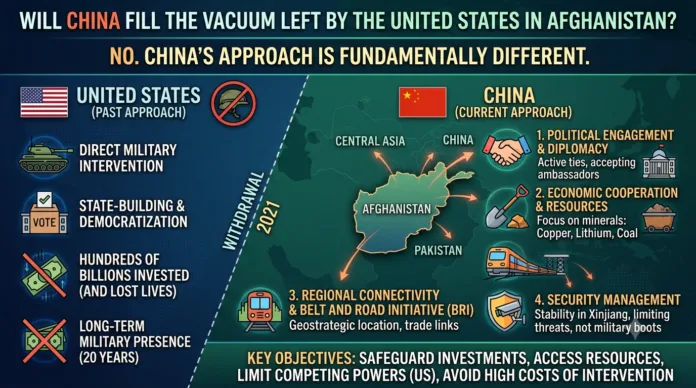
Given these developments, an important question arises: Will China fill the vacuum left by the United States in Afghanistan?
The answer is no.
China is unlikely to replace the United States in Afghanistan because its strategic approach fundamentally differs from that of Washington. Beijing has consistently avoided direct military intervention in Afghanistan and has shown little interest in becoming deeply involved in the country’s domestic political affairs. Chinese policymakers recognize that assuming the role previously played by the United States would impose enormous political, financial, and security costs with uncertain outcomes.
Instead, China’s policy toward Afghanistan is primarily based on political engagement, economic cooperation, and security management. Chinese investment has concentrated mainly on Afghanistan’s mineral resources, including copper, lithium, coal, and precious stones. Owing to its vast untapped natural resources, Afghanistan has long attracted the attention of both regional and global powers. Following the withdrawal of U.S. forces, China has found greater opportunities to expand its economic activities, particularly in the mining sector.
Beyond natural resources, Afghanistan occupies an important geostrategic position linking Central Asia, South Asia, and the broader Eurasian region. China seeks to utilize this geographic advantage to facilitate trade and strengthen its economic connectivity with neighboring markets.
The Belt and Road Initiative (BRI) further illustrates China’s long-term strategic vision for Afghanistan. Through this initiative, Beijing aims to develop regional infrastructure networks, improve connectivity, and promote economic development. Although Afghanistan has not yet become a fully integrated participant in the BRI, the country’s strategic location provides significant opportunities for future Chinese investment and regional integration.
Ultimately, China’s approach toward Afghanistan is driven primarily by national interests. Beijing seeks to safeguard its economic investments, secure access to strategic resources, and expand its diplomatic influence while minimizing security threats emanating from Afghanistan. At the same time, China aims to limit the influence of competing powers—particularly the United States—in Afghanistan through economic engagement and diplomatic cooperation rather than military intervention.
In conclusion, while China is expanding its political and economic presence in Afghanistan, it has neither the intention nor the strategic incentive to replace the United States as the country’s dominant external power. Rather than pursuing military involvement, Beijing prefers a pragmatic strategy centered on economic investment, diplomatic engagement, and regional stability, allowing it to protect its interests while avoiding the considerable costs associated with direct intervention.