✍ By Iftikhar Gilani – Indian Journalist
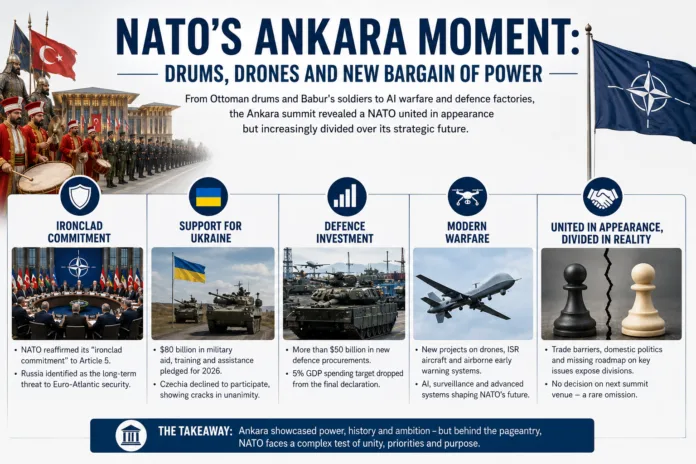
From Ottoman drums and Babur’s soldiers to AI warfare and defence factories, the Ankara summit revealed a NATO united in appearance but increasingly divided over its strategic future
History entered the NATO summit before diplomacy did.
At Türkiye’s Presidential Complex in Beştepe in the capital Ankara, the leaders of the world’s most powerful military alliance were welcomed not only by guards, protocol officers and flags, but by a theatre of memory.
Outside the palace, 16 soldiers stood in traditional armour, each representing one of the 16 historic Turkic kingdoms from the Great Hun Empire of 204 BC to the Ottoman Empire that lasted till 20th century, which Türkiye officially honours as part of its civilisational inheritance.
For an Indian observer, one figure stood out with particular resonance: the soldier representing the army of Babur, the first Mughal emperor of India, whom Turkish historical imagination places within the larger Turkic world because of his roots in Fergana, a region linked today with Uzbekistan, Kyrgyzstan and Tajikistan.
It was a small detail in a heavily choreographed summit. But such details often reveal more than communiqués. Babur may be part of a long debate over India’s medieval past, but in Ankara, he appeared as part of a Turkic continuum stretching from Central Asia to Anatolia. The symbolism was deliberate. NATO had come to discuss missiles, drones, Ukraine, Iran, Russia and defence spending. Türkiye welcomed it with an older message: geography is not merely territory; it is memory arranged as power.
Then came the Mehter.
The sound of the Ottoman military band rolled across the palace grounds before many of the handshakes took place. Mehter was once a psychological instrument of war, announcing the approach of Ottoman armies before battle. On a turquoise carpet, when guests, including President Donald Trump, walked on either side, drums, cymbals and zurnas greeted an alliance born in 1949 to defend the Atlantic order against the Soviet Union.
The venue, Beştepe Palace, was built after Recep Tayyip Erdoğan’s rise and the shift to a presidential system. The complex marks a conscious break from the older, more modest political style of Çankaya, where Turkish presidents and prime ministers once worked from comparatively restrained buildings. Its architecture draws less from the late Ottoman style familiar to many outside Türkiye and more from Central Asian Seljuk motifs.
Beside it stand a grand mosque and the presidential library, open to students and the public around the clock. Across from the complex is the July 15 monument, commemorating the failed 2016 coup attempt.
This was therefore not just a NATO summit hosted by Türkiye. It was NATO inside Erdoğan’s carefully constructed national stage.
Final Declaration Lacks Roadmap
For two days, Ankara became a city of motorcades, security cordons and diplomatic theatre. The final declaration tried to project unity. NATO reaffirmed its “ironclad commitment” to Article 5, the clause under which an attack on one member is treated as an attack on all.
It identified Russia as the long-term threat to Euro-Atlantic security, pledged $80 billion in military equipment, assistance and training for Ukraine in 2026, and announced more than $50 billion in new defence procurements. But experts say sustaining this support will be harder than announcing it. Czech Prime Minister Andrej Babis said his country would not participate in the package, underlining how national politics can puncture alliance unanimity even before the ink dries.
The Czech case produced one of the summit’s more revealing images. Unlike other delegations, Czechia was represented by both Prime Minister Babis and President Petr Pavel after a dispute over who should attend. Their delegations operated separately, and they travelled in separate aircraft. They sat far apart, as if domestic political rivalry had been physically inserted into alliance choreography.
But the declaration was also interesting for what it did not say. It avoided repeating the explicit 5 percent of GDP defence spending target pushed at the previous Hague summit. Spain and many other countries flagged that it means diverting resources from social spending and is a recipe for domestic unrest.
Experts believed that declaration promised to eliminate defence trade barriers among allies but gave no roadmap. It mentioned Iran and the Strait of Hormuz, but gave no operational plan for protecting shipping. It did not identify the next summit venue, an unusual omission in NATO’s summit practice. The document was short, but its silences were long.
At the Defence Industry Forum held on the sidelines, NATO’s future was on clearer display. Secretary General Mark Rutte confirmed the delivery of the tenth Airbus A330 multirole tanker transport aircraft to NATO’s multinational fleet. Seven allies launched a new multinational project around the Airbus A400M military transport aircraft. Denmark, Finland, Germany and Norway announced procurement of up to five MQ-4C Triton high-altitude, long-endurance uncrewed aircraft to strengthen NATO’s intelligence, surveillance and reconnaissance force.
Eleven allies announced the joint procurement of Saab GlobalEye aircraft to modernise NATO’s airborne early warning capability and replace part of the ageing American Boeing E-3 AWACS fleet.
Rutte’s warning was blunt. “We don’t have the luxury of time. Russia is putting almost half its national budget into its war machine, while its defence industry worked around the clock.” He said China was modernising its armed forces and expanding nuclear capabilities without transparency. North Korea was expanding its nuclear programme and supplying Russia.
In another moment, he used a football analogy. No team wins because of one brilliant player, he said. It needs the goalkeeper, defenders, midfielders, strikers, substitutes and those behind the scenes. “Everyone matters. No one wins alone. NATO is much the same.”
Divergences In Private Discussions
In private discussions, however, divergences over prioritising security threats were palpable between the US and European partners. Delegates from Europe were insisting that the war in Ukraine has clearly shown that the primary threat to security is Russia. They want plans to deter Russia by production, stockpiles and forward defence.
The US delegates, however, constantly mentioned China as its long-term strategic rival, militarily over Taiwan and structurally in technology, trade and global influence. They argued that Europe should carry more of its own burden so that American power can focus on Asia. Europe, meanwhile, still sees China as an indispensable economic actor even while it worries about Chinese strategic ambition. Many American delegates told Frontline that this divergence did not begin with Donald Trump, but Trump accelerated it.
In Ankara, Trump worked both as disruptor and dealmaker. He wanted credit for forcing Europe to spend more. He also wanted to remind allies that American patience had limits.
He used the summit to criticise European governments for what he saw as inadequate support during the recent U.S. confrontation with Iran. He revived his demand that the United States should control Greenland, arguing that the island was strategically vital because of Russian and Chinese activity in the Arctic.
Yet Trump was notably warm toward Erdoğan. Sitting beside the Turkish president, he said the United States would lift sanctions imposed on Türkiye over its purchase of the Russian S-400 missile system and would consider selling F-35 fighter jets to Ankara. “We don’t want to sanction friends,” Trump said, according to accounts of the meeting.
Ankara was removed from the F-35 programme after buying the S-400 system from Russia, a move Washington argued could compromise the stealth fighter’s security. Israel’s opposition added another layer. Prime Minister Benjamin Netanyahu has publicly opposed any F-35 sale to Türkiye, arguing that it would alter the regional balance of power. Greece, too, watches Turkish military modernisation with unease. But from Ankara’s perspective, the logic is straightforward. If NATO wants Türkiye’s army, drones, ships, air bases, intelligence, geography and defence industry, it cannot continue treating Turkish security requirements as secondary.
Erdoğan, while agreeing to increase defence spending to reach the 5 percent target ahead of schedule, also demanded that restrictions on defence cooperation among allies be lifted. The declaration’s reference to removing defence trade barriers was therefore not a minor line for Ankara. It was one of the summit’s most important political prizes.
Türkiye has spent years complaining of export restrictions, licensing delays and political conditions from its own allies. European restrictions followed Turkish military operations in Syria and tensions in the eastern Mediterranean.
A Turkish analyst at the summit put it more sharply: Türkiye no longer wants America and Europe to treat it as a country that needs NATO, but as a country that NATO itself has come to need.
The $24 billion reportedly allocated for the Steel Dome air defence architecture, the growing Turkish defence industry, and Ankara’s readiness to contribute from Kosovo to the Black Sea and the Baltic region are not merely military projects. They are bargaining chips in the remaking of Türkiye’s relationship with the West.
New Nucleus of NATO
Erdoğan now wants Türkiye recognised as a nucleus of NATO security, not its edge. One Turkish commentator described the country as an “atomic cell” within the alliance, capable of generating power at the centre rather than standing merely at the frontier. Türkiye sells drones to Ukraine while maintaining communication channels with Russia. It expands defence ties with Saudi Arabia and other Gulf states. It speaks sharply on Gaza and Lebanon. It watches Syria, Iraq, Iran and the Caucasus. It presents itself as mediator, supplier, military power and independent actor. The Ankara summit allowed Erdoğan to fold all these identities into one spectacle.
Prof. Mustafa Caner, from Sakarya University, argued that the inclusion of Iran and Hormuz in the final document showed NATO’s recognition of the southern flank. Traditionally, NATO’s strategic imagination has been dominated by Europe’s east and north. But the Iran conflict, Gaza, Lebanon, Syria and maritime security have forced the alliance to think beyond neat geographical compartments.
Retired colonel Ahmed Keser noted that terrorism was mentioned alongside Russia as a threat, which he interpreted as a response to Turkish expectations. “For years, Ankara has argued that NATO allies do not take Türkiye’s security concerns over terrorism seriously enough,” he said.
The summit language, in his view, helped satisfy the host country while the Iran reference helped satisfy the United States and the Ukraine package reassured Europe.
Alex Walmsley of RUSI described the summit as “hugely significant” because NATO had experienced an exceptionally turbulent year, with pressures from inside and outside the alliance. Continued support for Ukraine, he said, remained essential because if Ukraine were to fall, the consequences for Europe would be profound.
This is the heart of NATO’s Ankara problem. The alliance knows what it fears, but not all members fear the same thing in the same way. Poland and the Baltic states see Russia as immediate. Spain worries about the social cost of military spending. Türkiye sees Russia, terrorism, Syria, the Black Sea, the eastern Mediterranean and Iran through its own geography. The United States sees China beyond all this. NATO’s declaration can compress these anxieties into six points, but real policy cannot.
The most unusual omission was the absence of a named venue for the next summit. NATO declarations usually end by announcing where leaders will meet next.
The summit also produced one extraordinary anecdote that captured Türkiye’s flair for symbolism. Erdoğan gave NATO leaders engraved revolvers bearing their names, along with ammunition. British Prime Minister Keir Starmer told journalists on his flight home that he could not take his revolver back to Britain because of strict firearms laws. The weapon remained in Ankara to be decommissioned.
It was almost too perfect a metaphor. NATO came to Ankara to discuss deterrence. Türkiye gave its leaders weapons as gifts.
By the end of the summit, Ankara had achieved what it wanted. It had hosted 32 allies at the presidential complex. It had placed Turkish history, architecture and protocol at the centre of alliance theatre. It had secured language on defence trade barriers and terrorism. It had received public praise from Trump. It had reopened the F-35 conversation. It had shown that Türkiye’s defence industry is no longer peripheral to NATO’s future.
NATO, too, avoided an open rupture. It signalled that future warfare will be fought not only with soldiers and tanks but with sensors, satellites, drones, AI, logistics and production lines.
But Ankara also showed that NATO is becoming something more complicated than a Cold War alliance. It is now a bargaining arena between an anxious Europe, a transactional America, an assertive Türkiye and a war-battered Ukraine. It faces Russia in the east, Iran in the south, China on the strategic horizon, and its own voters at home.
As the summit ended, the drums of the Mehter seemed to linger over Beştepe. They belonged to another age, but they understood something modern diplomacy often forgets. Power is never only what is written in declarations. It is also what is staged, remembered, manufactured and withheld.
In Ankara, NATO declared unity. Türkiye demonstrated leverage. And between the two lay the real story of the summit.
***********************
NATO’s Other Security Debate: Protecting Children Online
While NATO leaders debated wars and military strategy in Ankara, their spouses turned attention to protecting children in an age of artificial intelligence, social media and opaque algorithms
As NATO leaders wrestled with wars in Ukraine and the Middle East, defence spending and the future of the transatlantic alliance, another conversation unfolded quietly across the Turkish capital, Ankara.
Inside the historic Çankaya Presidential Palace, the spouses of presidents and prime ministers focused on what many described as an emerging security challenge of a different kind: protecting children in the digital age.
Hosted by Türkiye’s First Lady Emine Erdoğan, the roundtable, “Children, Technology and Security: Protecting the Next Generation,” reflected a growing belief that national security today extends beyond military threats. It also includes the digital world where children increasingly grow up under the influence of artificial intelligence, social media and opaque algorithms.
The discussion brought together the spouses and partners of leaders from France, Germany, Canada, Ukraine, South Korea, Poland, Finland, Greece and several other NATO and partner countries. While no joint declaration was issued, participants broadly agreed that governments, technology companies and families all have a role in making the digital environment safer for children.
Opening the session, Emine Erdoğan argued that child safety should become a fundamental design principle for digital platforms rather than an optional feature added later. She called for greater transparency in the algorithms that shape online experiences and urged governments to require independent oversight of the societal impact of digital technologies.
Her remarks reflected concerns increasingly shared by policymakers across Europe and beyond. Studies showing rising levels of screen dependency, declining face-to-face interaction and the growing influence of artificial intelligence on young users have pushed governments to reconsider how technology should be regulated.
One statistic she cited captured the urgency of the debate.
According to UNICEF estimates, around sixty children enter the online world every thirty seconds. Each gains access to unprecedented opportunities for learning and communication, but also to manipulation, surveillance, misinformation and commercial exploitation.
Participants examined how recommendation algorithms, behavioural profiling and AI-powered systems are reshaping children’s attention, emotions and decision-making. Emine Erdoğan warned that technology increasingly influences not only what children see, but also how they think.
Türkiye used the occasion to highlight measures it has already introduced, including age-verification requirements, parental controls and restrictions on social media access for children under fifteen.
Although overshadowed by NATO’s high-level political agenda, the meeting underscored how the definition of security continues to evolve.
The threats confronting future generations may not come only from missiles or military confrontation. Increasingly, governments are recognising that they also emerge from invisible algorithms, artificial intelligence and digital platforms that shape the lives of children long before they become citizens, voters or soldiers.
Key takeaways and questions from the NATO Ankara Declaration
Takeaways
NATO signals a shift toward a wartime economy. The Alliance announced more
than $50 billion in new defence procurements and plans to expand manufacturing
capacity, making defence production a strategic priority.
Europe is expected to shoulder more of NATO’s defence burden. The declaration
says European Allies and Canada will assume greater responsibility alongside the
United States.
Support for Ukraine has become a long-term commitment. NATO pledged €70
billion in military aid, equipment and training for 2026 and signalled similar support
in 2027.
Russia remains NATO’s principal long-term security threat. Despite tensions in
the Middle East and Indo-Pacific, Moscow continues to dominate NATO’s strategic
planning.
Artificial intelligence becomes part of NATO’s military doctrine. The Alliance
will develop a transatlantic warfighting cloud and integrate AI into future military
operations.
The defence industry is now central to NATO strategy. The declaration focuses
heavily on industrial capacity, supply chains, innovation and production alongside
military capabilities.
Europe’s defence role is evolving. The phrase “A stronger Europe in a stronger
NATO” reflects growing European responsibility rather than dependence on
Washington.
Iran receives limited but significant attention. NATO reiterates that Iran must
never obtain nuclear weapons and calls for freedom of navigation in the Strait of
Hormuz.
NATO reaffirms collective defence. The declaration again stresses Article 5, stating
that an attack on one Ally remains an attack on all.
Key questions
Why was the explicit 5% defence spending target dropped? Unlike the Hague Summit
declaration, Ankara makes no direct commitment for all members to spend 5% of GDP on
defence.
Can European governments actually afford higher defence spending? Countries
such as Spain argue that larger military budgets would come at the expense of
healthcare, education and social welfare.
Will defence trade barriers really be removed? The declaration promises to
eliminate restrictions among Allies but provides no roadmap, timeline or
implementation mechanism.
Will Türkiye benefit from this commitment? It remains unclear whether export
restrictions and procurement barriers imposed on Türkiye’s defence industry and dual use technologies will be lifted.
How will NATO enforce freedom of navigation in the Strait of Hormuz? The
declaration urges Iran to respect maritime freedom but offers no strategy if attacks on
shipping continue or Iran imposes transit levies.
Why is NATO’s new fuel supply chain missing from the declaration? Secretary
General Mark Rutte announced a major fuel and pipeline initiative, but it is absent
from the final communiqué.
Why was the next NATO summit venue not announced? Previous summit
declarations usually identify the next host. The Ankara declaration simply says
leaders “look forward to our next meeting,” raising questions about whether Allies
failed to reach consensus.
How will NATO’s AI ambitions be implemented? The declaration announces a
transatlantic warfighting cloud and AI integration but provides few details on
governance, funding or timelines.
Does the declaration reflect growing divisions within NATO? The careful wording
on defence spending and the omission of several key issues suggest compromises
were needed to maintain Alliance unity.
Can NATO balance military expansion with domestic political pressures? Many
member states face slowing economies, rising debt and public resistance to shifting
resources from social programmes to defence.