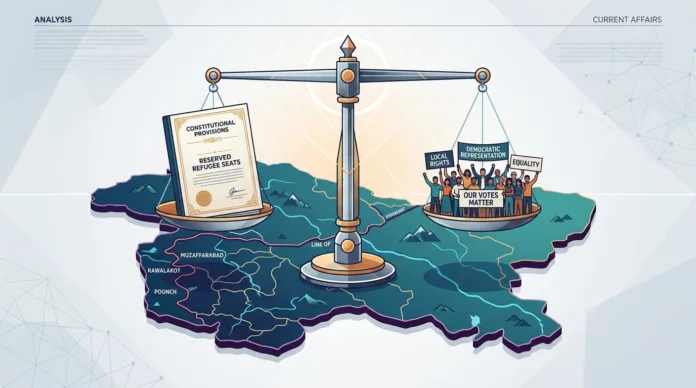
For more than two months, a sit-in has held the centre of Rawalakot. Around it, an election has been conducted in pieces — Mirpur first, then Muzaffarabad and the refugee constituencies, then two districts of Poonch — while seven constituencies in Rawalakot and Sudhnoti still wait for a polling date. More than fifty lives have been lost since the crisis escalated in June. This is the most serious internal crisis Azad Jammu and Kashmir has faced in its history, and it turns on a question that has nothing to do with the price of flour: whether twelve seats reserved for Kashmiri refugees should exist at all.
How a movement that began at the bazaar arrived at the constitution is the story worth telling.
A movement that won, and then changed the question
The Jammu Kashmir Joint Awami Action Committee was formed in 2023 by traders and activists agitating over the cost of wheat flour and electricity. Those were real grievances, and they were addressed. Islamabad and Muzaffarabad moved on subsidies and tariffs, and the movement’s own charter records the pattern: of thirty-eight demands, the AJK government says it has accepted thirty-seven, with two dozen already implemented. Judged against the standard by which protest movements are usually measured — did the state listen? — the JAAC has been remarkably successful.
The demand that has proved impossible to settle is the one that was not there at the beginning. The abolition of the twelve seats reserved in the Legislative Assembly for Kashmiris displaced from Indian-administered Kashmir was appended to the charter after the movement had gathered momentum. Negotiations that had produced concession after concession broke down over it in June. The government subsequently declared the committee a proscribed organisation — the designation it carries in law today— and the situation in Poonch deteriorated sharply thereafter.
The committee has described its campaign as a rights-based movement. The demand to abolish the refugee seats gives it a clearly political character. That is not an accusation; it is a description. A movement may of course seek constitutional change. But it must then accept that it is doing constitutional politics, and be answered on that ground rather than on the ground of subsidies.
The claim to stand outside politics is harder to sustain than the committee allows. Its core body is not a gathering of traders and shopkeepers alone: a substantial share of its senior members holds membership or office in parties and student organisations that campaign for an independent Jammu and Kashmir. There is nothing improper in that. Political workers are citizens, and in a territory with an elected assembly they are entitled to organise and to press their case. But an organisation whose leadership is drawn in significant part from a distinct political current cannot describe itself as non-political, and the state can hardly be faulted for reading its demands in the light of that current’s long-standing positions.
This is where a movement about the cost of living meets a question about the status of the territory. A campaign built on electricity tariffs and flour subsidies has arrived, by degrees, at a demand that would remove from the Legislative Assembly the one institutional feature tying it to the parts of the State that lie outside its administration. Whatever the intention behind it, the effect of that demand runs in a single direction, and it is not the direction of cheaper power. The narrative that mobilised Poonch was a narrative of rights; the demand it now carries belongs to the argument over what Jammu and Kashmir is. Those are different arguments, and the people who joined the first are owed a frank account of how they came to be enlisted in the second.
Why these seats are not an ordinary domestic matter
The case against the seats has a democratic logic that deserves to be stated at its strongest. Representatives elected by voters living in Punjab and Sindh sit in a legislature whose laws, budget and public services govern people in Muzaffarabad and Rawalakot. The disproportion is arithmetical as much as geographical: a resident constituency in AJK rests on tens of thousands of voters, while the electorate behind a refugee seat is a small fraction of that. Twelve members returned on that basis can help decide who forms a government they do not live under. The objection is not frivolous, and it will not go away because it is inconvenient.
But the seats were never designed as ordinary constituencies, and they cannot be abolished as though the territory were an ordinary province.
The entity in question calls itself the Azad Government of the State of Jammu and Kashmir. The nomenclature is not decorative. It asserts a claim to represent the whole of a State that remains an internationally recognised dispute, to be settled in accordance with United Nations resolutions. The refugee seats are the institutional expression of that claim: they are how a government that speaks for the whole State keeps a place in its own legislature for the part of that State it does not administer, and for the people driven out of it.
Strip that away and Pakistan’s own position becomes harder to argue. If a plebiscite is ever held under the UN resolutions, these refugees cannot be denied political representation. If they are denied political rights within the AJK system today, it becomes very difficult to insist internationally that they hold a legitimate right to vote on the State’s future tomorrow. A demand framed as democratisation would, in effect, concede that the Line of Control is a settled boundary and that those who crossed it have forfeited their political identity. That is India’s argument, not Kashmir’s.
Where the claim comes from
There is a further reason this dispute cannot be handled as a routine problem of public order, and it has nothing to do with any district’s claim to precedence.
The government whose nomenclature carries Pakistan’s case was itself brought into being in Poonch. The revolt of 1947 against Dogra rule was indigenous and unbidden; it began in the hills of Poonch, not in the Valley, whose politics at that moment were taking a different course altogether. Out of it came the Azad Government of the State of Jammu and Kashmir, under the leadership of Sardar Muhammad Ibrahim Khan — a Poonchi, and the same man at whose initiative the Muslim Conference, the only representative party of the Muslims of the Maharaja’s state, passed the accession resolution of 19 July 1947 in favour of Pakistan. The institution now being argued over, and the constitutional claim it embodies, were founded by the people currently sitting outside it.
That commitment did not end in 1947. It was renewed over the decades that followed, and the district’s integration into Pakistan’s national institutions, including its armed forces, is as deep as anywhere in the country. This is not an argument that Poonch is owed something for its history. It is an argument about consequence: a settlement reached while the constituencies that founded the Azad government are unrepresented in it, and a government formed without them, would leave a resentment that outlasts the sit-in by decades. The people who have historically preserved the State’s case are the last people the State’s case can afford to alienate.
The consequences of the deadlock are no longer contained within the territory. Kashmiri diaspora communities have demonstrated in capitals across the world, and the dispute has acquired an audience that neither Muzaffarabad nor Islamabad controls.
Allegations of foreign funding and external linkages have been levelled at the proscribed committee, and it rejects them. Wherever the truth lies, the argument that matters is not settled by them. This is a constitutional question, and it will have to be won on constitutional grounds — before an electorate in Poonch that is unlikely to be persuaded by anything else.
The wider cost is easier to see. Pakistan has traditionally claimed the moral high ground on Kashmir, and that ground rests on a simple contrast: the treatment of Kashmiris on one side of the Line of Control against their treatment on the other. If violence takes place in the part of Kashmir administered by Pakistan, it has serious implications for Pakistan’s position at international forums, and it will be raised at every one of them. Prolonging the deadlock is therefore not a neutral option. It carries a price that is paid outside the region, in the one arena where Pakistan’s case on Kashmir has always been strongest.
A way through
The dispute is not unsolvable; it has simply been posed in its most unsolvable form. Abolition is not available, for the reasons above. Nor is the status quo, because the underlying grievance about local democratic control is genuine.
What lies between them is recalibration rather than removal. The principle behind the refugee seats — that displacement does not extinguish political identity, and that the State’s representation cannot stop at the ceasefire line — can be preserved intact while the arithmetic that expresses it is corrected.
The concrete reform is to tie refugee representation to demographic proportion. The figure of twelve is not a principle; Fixing the number of seats to the verified size of the registered displaced electorate, relative to the electorate inside the territory, and revisiting it as that population changes, would answer the charge of disproportionate influence without conceding the claim that the seats exist to defend. Representation would then rest on the same democratic measure everywhere in the house — which is precisely the standard the protesters say they want applied.
A second reform addresses the sharper part of the grievance. The refugee members’ votes should not count in any in-house change of government — the election of a prime minister, a motion of no confidence, or the arithmetic that decides who governs. It is here, and largely only here, that the seats have been a resource for political engineering rather than an expression of representation, and it is here that voters inside the territory can most fairly say they are being governed by an electorate that does not live among them. For every other legislative purpose — debate, committee work, budget scrutiny, the passage of legislation — the refugee members should be treated exactly as their colleagues are, because on those matters their mandate is precisely the point of their presence.
Taken together, the two changes concede what the grievance is really about while conceding nothing of the claim. Displaced Kashmiris keep a full legislative voice in the house that speaks for the whole State; the government of Azad Jammu and Kashmir is made and unmade by those who live under it.
What each side has to do next
None of this can be legislated from a sit-in. Two things have to happen before the Assembly can take up an amendment at all.
The polls in Rawalakot and Sudhnoti should be completed, so that Poonch is represented in the house where any amendment must be moved and passed. A constitutional settlement negotiated over the heads of the constituencies most affected by it will not hold. Alongside that, the accepted demands still awaiting implementation should be delivered visibly, because credibility in the harder argument depends on performance in the easier one.
The leadership of the proscribed committee, for its part, now has to reckon with where the sit-in has arrived. It has won most of what it set out to win. It has not won the twelve seats, and it will not win them on the road, because the road cannot amend a constitution. If submitting to the legal process is what it takes to reopen negotiations, that is not a defeat after everything the leadership has already accepted for a larger cause — it is the last step of the same commitment, and the one that converts a movement into a settlement. Leaders who have carried a public with them this far can carry it to a table.
Azad Jammu and Kashmir is not asking Pakistan to give up Kashmir. It is asking to be governed in proportion to those who live there, and by those who live there. The twelve seats are asking Pakistan not to give up the Kashmiris it has always said it speaks for. Both claims are legitimate, and a settlement that honours both is available — through the ballot, and through an amendment that counts people rather than abolishes them.
✍ Dr. Umair Pervez Khan holds a PhD in International Relations. His research spans Eurasian and South Asian geopolitics, with a focus on Indian strategic culture, nationalism and populism, democratic governance, and the Kashmir conflict