✍ By Saima Afzal – Pakistan
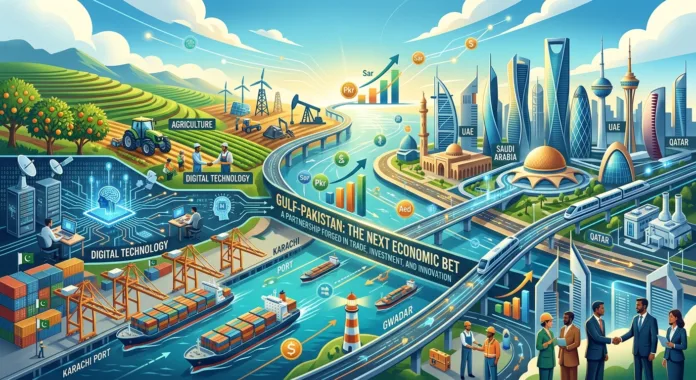
The Gulf’s economic transformation could reshape Pakistan’s relationship with some of its closest regional partners. For decades, economic ties with Saudi Arabia, the United Arab Emirates and Qatar have centred on labour migration, remittances, energy cooperation and diplomatic engagement. Now, as Gulf economies diversify into technology, infrastructure, food security and advanced industries, Pakistan has an opportunity to move beyond supplying labour and become a more productive economic partner.
Yet longstanding political relationships and geographical proximity do not guarantee investment. Gulf investors seek commercially viable projects, competitive industries, reliable supply chains and predictable economic policies. Pakistan possesses agricultural resources, a growing digital sector, mineral deposits, maritime access and a large workforce. The challenge is to translate these advantages into partnerships that generate exports, skilled employment and sustainable growth.
Saudi Arabia’s Vision 2030, the UAE’s diversification initiatives and Qatar’s long-term development strategy are reshaping the Gulf’s economic priorities. These countries are expanding international supply chains, developing new industries and seeking commercial partners across Asia. Pakistan could benefit from this shift, but it competes with economies offering stronger infrastructure, established export industries and more predictable regulations. Its strategic relationships must therefore be supported by credible economic performance.
Labour mobility remains the strongest foundation of Pakistan’s economic relationship with the Gulf. According to State Bank of Pakistan figures, overseas Pakistani workers sent home approximately $41.6 billion during fiscal year 2025–26, an 8.6% increase from the previous year. Saudi Arabia contributed around $9.8 billion, while the UAE accounted for approximately $8.8 billion. These inflows support Pakistan’s foreign-exchange position and millions of households, but remittances alone cannot create a competitive export economy.
As Gulf economies develop technology, healthcare, logistics and advanced manufacturing industries, demand for specialised skills offers Pakistan an opportunity to upgrade its labour relationship. Joint vocational training programmes, internationally recognised qualifications and partnerships with Gulf employers could help Pakistani workers enter higher-paying professions while meeting the region’s changing labour requirements.
Technology offers another avenue for cooperation. Pakistan’s information and communication technology export earnings reached approximately $4.6 billion in fiscal year 2025–26, recording reported annual growth of around 20.6%. Meanwhile, Saudi Arabia and the UAE are investing in artificial intelligence, cybersecurity, financial technology and cloud computing. Pakistani firms could establish software development partnerships, specialised service centres and joint ventures with Gulf businesses.
However, Pakistan faces competition from India, Southeast Asia and other established technology markets. Unreliable internet connectivity, inconsistent taxation, international payment difficulties and shortages of advanced technical skills remain obstacles. To compete effectively, Pakistan must develop higher-value digital products and specialised engineering services rather than depend exclusively on low-cost outsourcing.
Food security provides another opportunity. Gulf countries face agricultural constraints because of water scarcity and limited cultivable land. Pakistan’s agricultural, livestock and fisheries sectors could help diversify their food supplies while creating export opportunities. Yet Gulf buyers require consistent quality, food-safety certification, refrigerated transport and dependable delivery schedules. Investment in food processing, cold storage, modern irrigation and logistics could strengthen Pakistan’s agricultural competitiveness. Such expansion must also account for Pakistan’s own water shortages, climate risks and domestic food-security needs.
Maritime infrastructure could connect these sectors more effectively with Gulf markets. In June 2023, the UAE-based AD Ports Group signed a 50-year concession agreement with Karachi Port Trust to develop and operate the Karachi Gateway Terminal, including plans for approximately $220 million in infrastructure investment during the first decade. The agreement demonstrates Gulf commercial interest in Pakistan’s logistics sector, although planned investment should not be confused with completed expenditure.
Gwadar Port and the China-Pakistan Economic Corridor (CPEC) provide another potential link between Gulf markets, western China and Central Asia. These routes could support regional trade diversification, but their strategic location alone does not guarantee commercial success. Their value depends on security, transport efficiency, customs procedures and sufficient demand to justify investment.
Mineral resources could also attract Gulf investors seeking access to materials needed for industrial development and energy technologies. However, Pakistan’s Reko Diq copper-gold project illustrates the challenges of large-scale investment. In April 2026, Barrick Mining Corporation announced that it would slow development while reviewing the project until mid-2027, citing security concerns and the need to reassess financing and project requirements.
Although Reko Diq is not presented here as a Gulf-backed project, its difficulties highlight risks that prospective international investors must consider. Mineral potential alone cannot overcome security concerns, regulatory uncertainty or inadequate infrastructure. Successful investment also requires transparent contracts, local employment opportunities and economic benefits for communities surrounding major projects.
Pakistan has sought to improve investment coordination through the Special Investment Facilitation Council (SIFC), established in 2023 to facilitate investment in agriculture, minerals, energy and technology. The initiative is particularly relevant to efforts to attract Gulf capital. Yet institutional coordination cannot substitute for affordable energy, contract enforcement, regulatory predictability and reliable infrastructure.
For Gulf countries, Pakistan offers different opportunities rather than a single investment proposition. Saudi Arabia could expand cooperation in industrial development, agriculture and skilled employment. The UAE could strengthen its involvement in ports, logistics and technology services, while Qatar could explore partnerships in food security, technical training and professional services. Each opportunity requires commercially viable projects and sector-specific agreements rather than broad diplomatic commitments.
The contrast between the Karachi Port concession and the Reko Diq slowdown illustrates an important distinction: investment interest does not necessarily translate into economic results. Announcements and signed agreements are useful starting points, but functioning infrastructure, productive businesses, export earnings and sustainable jobs offer stronger measures of success.
Pakistan’s relationship with the Gulf could gradually evolve from one centred on labour migration and financial support towards productive economic interdependence. Such a transition would strengthen Pakistan’s participation in regional supply chains while giving Gulf economies another potential partner in their diversification strategies. However, it will require Pakistan to improve competitiveness, institutional reliability and the investment environment.
The Gulf’s transformation presents a genuine opportunity, but not an unconditional promise of investment. Pakistan has the resources, workforce and longstanding regional relationships needed to pursue deeper economic cooperation. Whether these advantages generate lasting growth will depend on its ability to deliver competitive exports, commercially viable projects and reliable economic policies. Geography opens the door; economic performance will determine what follows.
About the Author: Saima Afzal is a researcher specializing in South Asian security, counterterrorism and geopolitical developments across the Middle East, Afghanistan and the Indo-Pacific. Her work examines strategic affairs and evolving patterns of regional conflict. She is currently a Research Scholar at Justus Liebig University, Germany.