✍ Ali Mehar – Pakistan
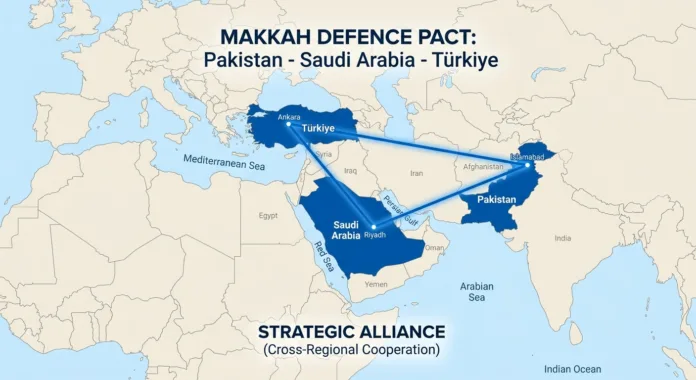
The Makkah Joint Defence Agreement signed on August 7, 2026 by Pakistan, Saudi Arabia, and Türkiye establishes a new paradigm for collective security cooperation between three strategically significant Muslim majority countries. According to the agreement, an armed attack on any of the three countries shall be considered an attack on all three countries, while the parties commit themselves to increasing their cooperation and collective deterrence.
The agreement has received a new lease on life in light of the recent attacks by Yemen’s Houthis on Saudi Arabia and the worsening of security conditions in the region surrounding the Red Sea. The first question that comes to mind in this context is that whether this agreement obligates Pakistan to become involved in the conflict in Yemen. A research article published in US-based Responsible Statecraft suggests that the answer to this question is not quite so simple.
The distinction is crucial since the Makkah agreement is officially termed by Pakistan to be of a defensive character. As per Pakistan’s Ministry of Foreign Affairs, the agreement aims at bolstering collective deterrence towards external attacks and it is not aimed at any specific state. The agreement also mentions the concept of individual and collective self-defense as per Article 51 of the UN Charter.
Consequently, an attack on Saudi territory does not necessarily translate into an automatic Pakistani combat operation inside Yemen. Collective-defence arrangements can involve different forms of assistance, depending on circumstances. Responsible Statecraft notes that Pakistan’s possible contribution could range from military and logistical assistance to intelligence cooperation, air defence and diplomatic engagement.
There is an already established military presence of Pakistan in Saudi Arabia, offering Islamabad choices in its approach to the Yemen conflict that fall short of undertaking offensive actions on the Yemeni soil. According to Responsible Statecraft, Pakistan currently has 8,000 troops and 16 aircraft in Saudi Arabia. Having such a military presence enables Pakistan to provide logistical and operational assistance in many ways, including sharing intelligence and cooperating in air defense.
Strategic ambiguity is another important component of Pakistan’s posture. Islamabad has avoided publicly defining every circumstance in which it would respond or specifying precisely what form that response would take. Such ambiguity can preserve flexibility while preventing potential adversaries from developing their plans around a clearly announced Pakistani response threshold. Responsible Statecraft argues that uncertainty over the precise escalation thresholds can itself contribute to deterrence.
At the same time, Pakistan’s leadership has made clear that the agreement is not merely symbolic. Defence Minister Khawaja Asif has stated that Pakistan is bound by the terms of the pact and would honour them when required. Following attacks connected to the Yemen conflict, he also warned that the agreement could become operational if the conflict spilled over into Saudi Arabia.
The distinction between attacks of limited scale and a major assault is therefore significant. A large-scale ground offensive into Saudi territory would represent a substantially different level of escalation from isolated missile or drone attacks. According to the Responsible Statecraft analysis, such an escalation could create stronger grounds for a more direct Pakistani military response. The same logic would apply to any serious threat to the territorial security of Saudi Arabia or to the holy cities of Makkah and Madinah.
The protection of the holy sites carries particular political and strategic sensitivity for Pakistan. Khawaja Asif has described any attack on Makkah or Madinah as a “red line” that would warrant a Pakistani response even in the absence of a mutual-defence agreement. This position indicates that Pakistan’s assessment of a threat would not be based solely on the formal language of the pact, but also on the nature and location of the threat.
Diplomacy nevertheless remains another major instrument available to Islamabad. Pakistan has longstanding relations with Saudi Arabia while also maintaining channels with Iran. Responsible Statecraft argues that Pakistan’s ability to engage Iran could provide an avenue for diplomatic pressure aimed at restraining the Houthis and preventing further regional escalation. This could allow Islamabad to support Saudi security while simultaneously pursuing de-escalation.
The wider strategic importance of the Bab el-Mandeb Strait further complicates the situation. The waterway connects the Red Sea with the Gulf of Aden and is vital to international trade and energy transportation. Any prolonged disruption would have consequences well beyond Saudi Arabia and Yemen. Pakistan therefore has an interest in regional maritime stability, but a unilateral Pakistani operation to secure Bab el-Mandeb would represent a considerably broader undertaking than the defensive purpose of the Makkah agreement.
A more plausible framework for Pakistani participation in maritime security would be a broader international coalition. Such an approach could allow Pakistan to contribute naval, logistical or other capabilities to protecting freedom of navigation while avoiding the transformation of the Makkah pact into an open-ended mechanism for military operations inside Yemen. Responsible Statecraft similarly argues that securing the waterway would be more likely to occur through a wider international effort.
The institutional development of the Makkah agreement also suggests that its purpose extends beyond the immediate Yemen crisis. At their August 31 meeting in Istanbul, Pakistan, Saudi Arabia and Türkiye agreed to establish a permanent secretariat in Saudi Arabia and to strengthen defence capabilities through joint activities, defence-industry cooperation and technology development. The three countries also reiterated their commitment to de-escalation and peaceful resolution of regional crises.
This agreement thus gives Pakistan room for manoeuvre in terms of strategic options. Islamabad may use a combination of deterrence along with diplomacy, defensive support, logistics, intelligence sharing and air defence, reserving the more direct military action for a situation where the threat is significantly higher. The trick would lie in keeping the credibility of collective defence high without every single attack turning into a wider war.
In the case of Pakistan, the question is not just whether it should get involved in the war in Yemen or not. The real question is how to determine the nature of involvement based on the level of threat without endangering Saudi Arabia and destabilizing the region. The Makkah agreement allows for just that graded approach.
Bio
Ali Mehar is an independent researcher and commentator on international relations, strategic affairs, and regional security. His work examines geopolitical developments, foreign policy, and emerging global trends, with a focus on South Asia, the Middle East, and evolving international dynamics.