
✍ By Afroz Alam Sahil – India
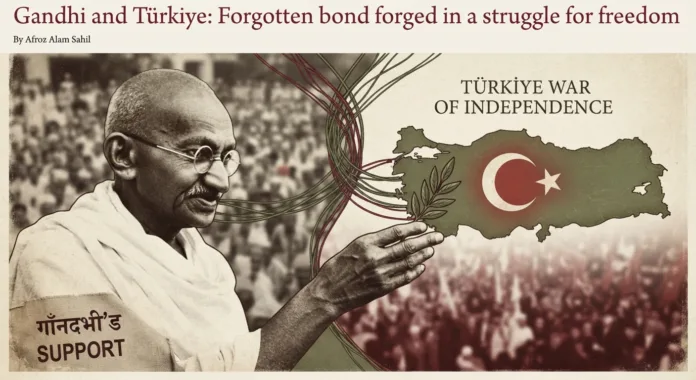
India’s freedom icon Gandhi’s support for Türkiye during its War of Independence helped turn the Turkish cause into a powerful platform for India’s anti-colonial struggle and Hindu-Muslim unity
As India marks Mahatma Gandhi’s birth anniversary on October 2, a little-known chapter of his political life reveals a remarkable connection with Türkiye and the Turkish War of Independence.
Long before the Republic of Türkiye was proclaimed under Mustafa Kemal Atatürk, India’s freedom icon Gandhi was closely following political developments in the Ottoman Empire and writing about Türkiye’s future.
Later, as the victorious Allied powers sought to determine the fate of Ottoman territories after the First World War, Gandhi opposed the dismemberment of Türkiye, returned his British medals over London’s policy toward the Turkish question, and helped turn support for Türkiye into a mass political cause in India.
In India, the movement that emerged in support of the Turkish cause became historically known as the Khilafat Movement because the future of the Ottoman Caliphate was central to the mobilization of Indian Muslims. Yet the movement unfolded during the same crucial years in which the Turkish people were resisting foreign occupation and partition, and Mustafa Kemal Atatürk was leading the Turkish War of Independence.
The objectives of the Indian Khilafat Movement and the Turkish national movement were not always identical, and they eventually diverged over the future of the Caliphate, but both emerged from the upheaval that followed the Ottoman defeat and the attempts by the victorious powers to determine Türkiye’s political and territorial future.
For Gandhi, Türkiye gradually became much more than a distant foreign-policy question. It became a test of British promises, a question of justice for his Muslim compatriots, and eventually a powerful platform for bringing Hindus and Muslims together in India’s struggle against colonial rule.
Gandhi’s faith in Türkiye’s future
Gandhi’s interest in Türkiye began long before the First World War and the Turkish War of Independence. He regarded Turks as brave warriors, wrote approvingly to his Indian readers about the tradition and benefits of the Turkish bath, and even expressed a desire to visit the country.
More significantly, he followed Türkiye’s political evolution closely and hoped that democratic government would enable its people to build a freer and more prosperous future.
When constitutional changes were taking place in the Ottoman Empire in 1908, Gandhi welcomed them enthusiastically.
Writing in the Gujarati edition of Indian Opinion on August 1, 1908, he told his readers about the political reforms associated with the Young Turks and the restoration of constitutional government.
“Reports have appeared in newspapers that the Young Party [presumably a reference to the Young Turks] in Turkey has brought about reforms in the Government. The people are pleased…because the Sultan has adopted a constitution for the governance of the country, and the occasion is being celebrated everywhere. The news agency also reports that Turkey will soon have a Parliament similar to the British Parliament.”
Gandhi described it as “an epoch-making development.”
He understood Türkiye’s strategic importance and appeared remarkably confident about its future. He believed parliamentary government could help the country attain a position comparable with the leading European powers.
“Turkey has among its common people and nobility men of such stature that, when she comes to have a Parliament, they can put her on par with the great European states, and indeed make her a world power. The country is so situated that it can achieve a commanding position,” Gandhi wrote.
His interest continued. On January 30, 1909, Gandhi wrote in the same publication that Britain’s attitude toward Türkiye had changed following the establishment of parliament.
“The moment a parliament was established in Turkey, the British became respectful. More than 300 members of the House of Commons sent a message of goodwill to the [Turkish] Parliament.”
These observations came more than a decade before the Turkish national struggle reached its decisive phase. They show that Türkiye was already present in Gandhi’s political thinking and that he viewed constitutional government and political sovereignty as important to the country’s future.
Turkish question became Indian cause
The First World War dramatically transformed the significance of Türkiye for India.
The Ottoman Empire emerged defeated, and the victorious Allied powers began deciding the future of its territories. The possibility of the Ottoman state being partitioned generated deep anxiety among Muslims in British India, for whom the Ottoman sultan also held the position of caliph.
The movement that emerged in the Indian subcontinent became known as the Khilafat Movement. Its immediate vocabulary reflected concern for the Caliphate, but it was also inseparable from opposition to the proposed territorial dismemberment of Türkiye.
At approximately the same historical moment, the Turkish national movement under Mustafa Kemal was resisting foreign occupation and the postwar arrangements that threatened Turkish sovereignty. What Indians called the Khilafat cause therefore developed against the larger background of the struggle that Turkish historical memory now remembers as the Turkish War of Independence.
Gandhi became one of the most prominent Indian leaders to champion this Turkish cause.
For him, Britain’s conduct toward Türkiye was increasingly evidence of a larger problem with imperial rule. If British promises concerning Türkiye could not be trusted, he believed Indians had reason to question the moral legitimacy of British authority in their own country.
This convergence helped bring the Turkish question into the center of India’s emerging mass movement against colonial rule.
Gandhi returned his medals
One of the clearest demonstrations of Gandhi’s commitment came in 1920, when he returned honors that had been bestowed upon him by the British Empire.
Gandhi surrendered the Kaiser-i-Hind Gold Medal and two other British honors. One had been awarded for his service as Officer-in-Charge of the Indian Volunteer Ambulance Corps during the Zulu War of 1906, while another recognized his role as Assistant Superintendent of the Indian Volunteer Stretcher Bearer Corps during the Boer War of 1899-1900.
In a letter dated August 2, 1920, addressed to Viceroy Lord Chelmsford, Gandhi made clear that he was returning the medals as part of the Non-Cooperation Movement launched in connection with the Khilafat cause and Britain’s policy toward Türkiye.
“Valuable as these honours have been to me, I cannot wear them with an easy conscience, so long as my Mussalman countrymen have to labour under a wrong done to their religious sentiment,” he wrote.
His criticism of the British government was equally explicit.
“Imperial Government have acted in the Khilafat matter in an unscrupulous, immoral and unjust manner, and have been moving from wrong to wrong in order to defend their immorality. I can retain neither respect nor affection for such a Government.”
Returning the medals carried significance far beyond the honors themselves. Gandhi was renouncing decorations he had received for service connected with the British Empire because he believed that the same imperial government had committed a grave injustice against Türkiye and the religious sentiments of India’s Muslims. The Turkish question had consequently become part of his broader moral and political rejection of British rule.
Why Gandhi supported Türkiye
Gandhi’s support for the Turkish cause also exposed him to criticism from people who otherwise respected his politics.
In 1920, one of his South African friends, then living in England, wrote to him after reading a report in The Times. According to the report, Gandhi was advocating an alliance between Hindus and Muslims to challenge Britain and its allies over the partition of the Ottoman Empire and the possible removal of the Turkish government from Constantinople, now Istanbul.
The friend appealed to Gandhi’s “sense of justice” and “humane instincts,” questioning whether his support for Türkiye meant overlooking conditions in Syria and Armenia. He asked whether Gandhi, by supporting the Turkish cause, had neglected his wider moral responsibilities.
“I am personally familiar with the conditions in Syria and Armenia, and I can only suppose that if the report which The Times has published is correct, you have thrown to one side your moral responsibilities and allied yourself with one of the prevailing anarchies…Perhaps you will do me the favour of sending me a reply.”
Gandhi did more than send a private response. Believing that similar questions might be troubling other English friends, he published the substance of his answer in the April 28, 1920, issue of Young India.
The title he chose was itself revealing: “Why I Have Joined the Khilafat Movement.”
“It is just my sense of moral responsibilities which has made me take up the Khilafat question and to identify myself entirely with the Mohammedans [Muslims]… I do not know how far the condition of Armenia and Syria may be considered an ‘anarchy’ and how far the Turkish Government may be held responsible for it,” Gandhi wrote.
Gandhi expressed skepticism about some of the reports concerning Armenia and Syria, which he believed were likely exaggerated, and argued that European powers also bore responsibility for mismanagement and instability in those regions.
His larger argument concerned the fate of Türkiye itself. If partition had always been the intention of the Allied powers, Gandhi maintained, that intention should have been made clear at the beginning of the war. Had that happened, there could have been no subsequent question of promises being broken. As matters stood, he wrote, Indian Muslims no longer placed trust in assurances given by British ministers.
Gandhi’s reasoning therefore went beyond the institutional future of the Caliphate. He was questioning the right of imperial powers to make commitments during wartime and then determine Türkiye’s future after victory on substantially different terms.
Türkiye and Hindu-Muslim cooperation
The Turkish question also gave Gandhi an opportunity to pursue an objective that he regarded as essential for India’s own freedom struggle: political cooperation between Hindus and Muslims.
The Khilafat leadership had succeeded in transforming events thousands of kilometers away into a mass political question in India. Gandhi recognized the potential of that mobilization and linked it with his Non-Cooperation Movement against British rule.
For Indian Muslims, anxiety over Türkiye and the Caliphate provided the immediate emotional and political impetus. For Gandhi, standing with them was both a moral commitment and a means of building a united challenge to colonial authority.
For a brief but significant period, the Turkish question therefore provided one of the strongest platforms for Hindu-Muslim political cooperation in colonial India.
The memory of that extraordinary period has not entirely disappeared.
Khilafat House: Surviving link with Türkiye
More than a century later, a physical reminder of India’s mobilization for the Turkish cause still survives in Mumbai.
In Byculla stands Khilafat House, historically associated with the All India Khilafat Committee. The institution emerged from the political movement that mobilized Indian Muslims and their allies over the future of Türkiye after the First World War.
The building and the organization associated with it remain reminders of a period when developments in Istanbul and Anatolia could draw enormous political gatherings in colonial India.
Gandhi’s association with the movement was crucial because he helped connect the campaign supporting Türkiye with the wider Indian struggle against British rule. The Khilafat question consequently moved beyond Muslim political organizations and became part of the broader Non-Cooperation Movement.
The survival of Khilafat House and the Khilafat Committee in Mumbai gives this history an unusual contemporary presence. More than a century after the Turkish War of Independence, an institution born from Indian mobilization over Türkiye still carries the name of that movement.
Türkiye in Gandhi’s sedition case
Perhaps the least-known connection between Gandhi and Türkiye lies in the case that eventually sent him to prison.
Gandhi was arrested in Ahmedabad on March 10, 1922, and charged with sedition for allegedly inciting hatred and rebellion against the British Empire through his newspapers Young India and Navjivan.
The writings surrounding the case did not concern India’s independence alone. His political writings during this period also contained passionate arguments about Türkiye’s sovereignty and the Khilafat cause, reflecting the extent to which the Turkish question had become intertwined with his wider confrontation with British imperial rule.
Gandhi was ultimately sentenced to six years in prison.
This produces a striking historical convergence.
On October 29, 1923, when the Republic of Türkiye was proclaimed, Gandhi had already spent 598 days behind the dark stone walls of Yerwada prison in Pune.
While Mustafa Kemal Atatürk and the Turkish national movement had succeeded in overturning the postwar settlement and establishing a sovereign republic, Gandhi remained imprisoned by another arm of the same imperial order against which he was struggling in India.
Their methods and political objectives were different. Gandhi’s philosophy of nonviolent resistance cannot be equated with the armed struggle of the Turkish national movement, and the Indian Khilafat Movement cannot simply be treated as the Indian branch of Mustafa Kemal’s movement.
Nevertheless, the histories intersected in a remarkable way. The struggle over Türkiye’s future became part of India’s anti-colonial politics, while the Turkish success in resisting an externally imposed settlement resonated in a subcontinent still under British rule.
Forgotten bridge between India and Türkiye
Today, Gandhi is remembered primarily for India’s independence struggle and his philosophy of nonviolence. His engagement with Türkiye receives considerably less attention, even though it occupied an important place in his political writings and actions during some of the most consequential years of his public life.
He had followed Türkiye’s constitutional development as early as 1908 and expressed confidence that parliamentary government could enable it to become a major power. After the First World War, he opposed Britain’s policy toward Türkiye, returned his British medals, publicly explained why his moral convictions had led him to join the Khilafat cause, and helped connect Indian support for Türkiye with a mass campaign against British colonial rule.
The terminology reflects the different historical experiences of the two countries. In India, the mobilization of 1919-1924 remains historically associated with the Khilafat Movement because the Caliphate initially stood at the heart of Muslim political mobilization. In Türkiye, the defining national memory of those years is the Turkish War of Independence under Mustafa Kemal Atatürk, which defeated attempts to partition the Turkish homeland and culminated in the establishment of the Republic.
The subsequent abolition of the Caliphate by Türkiye in 1924 demonstrated that the objectives of the two movements were never identical. Yet that later divergence should not erase the remarkable convergence that preceded it, when the future of Türkiye became an Indian political cause and helped bring Hindus and Muslims together against British colonial rule.
The connection is still visible today in Mumbai’s Khilafat House, but its deeper legacy lies in the political history shared by two societies thousands of kilometers apart.
As Türkiye emerged from its War of Independence and India intensified its struggle against British rule, both societies were confronting, in their different ways, questions of sovereignty, dignity and the right of peoples to determine their own political future.
On Gandhi’s birth anniversary, this largely forgotten chapter offers another way of understanding him: not only as a leader of India’s freedom movement, but also as an Indian voice who followed Türkiye’s political transformation, stood against its postwar dismemberment and made the Turkish question part of India’s own confrontation with empire.