The Makkah Joint Defence Agreement has provided a fresh security cooperation mechanism for Pakistan, Saudi Arabia, and Türkiye, but this agreement has far-reaching significance not only in terms of direct involvement of Pakistan in the Yemen conflict. With instability being witnessed in the region, especially in the Arabian Peninsula, Red Sea, and the Gulf, regional countries will need to build their deterrent capabilities without allowing a situation of uncontrollable warfare.
Signed in August 2026, the agreement provides a framework for collective defence such that an armed attack on any of the three countries will be treated as an attack on all. Islamabad has stated that the agreement is a matter of defence and not offense, stressing collective security, deterrence, and cooperation between the three countries, a consideration especially important given the ongoing conflict with the Houthis in Yemen.
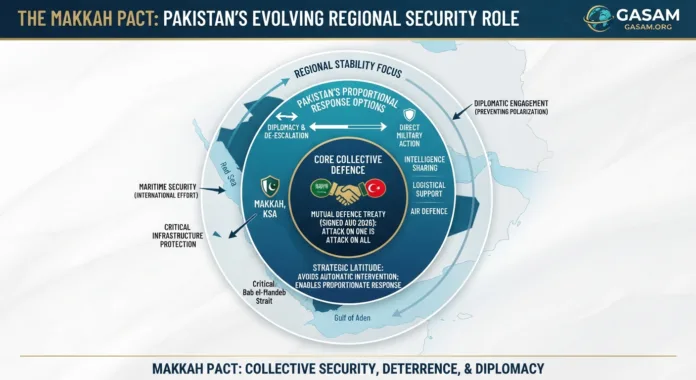
The first issue is whether the deal makes the military activities of Pakistan in Yemen automatic. According to an article published on Responsible Statecraft, a US website, whether Pakistan will take part in military actions in Yemen or not largely depends on the situation. The agreement implies that countries should defend each other. Nevertheless, it does not mean that every time the attacks are launched from Yemen, Pakistan will launch strikes or undertake military operations there. In fact, Islamabad has a number of options depending on how much it wants to get involved into the military conflict.
It is worth mentioning that Pakistan’s interests include the safety of Saudi Arabia and the prevention of the spread of conflict throughout the region. Traditionally, Islamabad has good relations with Riyadh in terms of defense. As Responsible Statecraft mentions, Pakistan maintains at least 8,000 troops and 16 aircrafts in Saudi Arabia. Thus, the infrastructure that already exists in the region enables Islamabad to contribute to Saudi defenses and avoid opening a new military front in Yemen.
Air defence, intelligence sharing, logistical support and protection of critical infrastructure could therefore become important elements of a Pakistani response. Such measures would allow Islamabad to demonstrate its commitment to Saudi security while retaining control over the level of escalation. In strategic terms, this gives Pakistan room to respond proportionately rather than treating every incident as requiring the same military reaction.
The ambiguity surrounding Pakistan’s exact response is also significant. Islamabad has not publicly established a detailed operational formula explaining what forces would be deployed, under which circumstances or at what stage. While this may leave some questions unanswered, strategic ambiguity can also preserve flexibility. Potential adversaries cannot easily calculate the precise limits of Pakistan’s response, while Saudi Arabia retains confidence that Islamabad has options available if the security situation deteriorates.
The threshold could change substantially if attacks were to develop into a direct and sustained threat to Saudi territory. A large-scale ground offensive, for example, would represent a different security situation from isolated missile or drone attacks. The same would apply to any direct threat to Makkah or Madinah. Defence Minister Khawaja Asif has said that Pakistan is bound by the Makkah Defence Agreement and would fulfil its obligations when required. He has also described any attack on Makkah or Madinah as a red line for Pakistan, regardless of whether a formal mutual-defence agreement existed.
This distinction between limited attacks and an existential or territorial threat is likely to remain central to Pakistan’s calculations. Islamabad has to maintain the credibility of its defence commitment without creating an automatic pathway from every regional incident to direct military confrontation.
Diplomacy consequently remains an important component of Pakistan’s strategy. Pakistan maintains close relations with Saudi Arabia but has also retained channels of communication with Iran. These relationships give Islamabad an opportunity to pursue de-escalation alongside its defence commitments. Responsible Statecraft specifically highlights Pakistan’s potential ability to engage Iran on the question of restraining Houthi activity.
Such diplomacy might become even more important if the attacks risk disrupting the greater security environment of the Red Sea. One such strategically vital waterway in the world is the Bab el-Mandeb Strait, which connects the Red Sea with the Gulf of Aden. Disruption of the waterway affects the shipping, energy transport, and global supply chain. For Pakistan, therefore, regional instability is not just a security matter between Saudi Arabia and Yemen but has wider ramifications.
Pakistan, on its own part, may contribute to maritime security by means of an international arrangement as opposed to getting involved in combat operations in Yemen. As mentioned by Responsible Statecraft, Pakistan’s involvement in securing the waterway would be more of an international coalition effort.
In addition, such an approach will be in line with Pakistan’s broader foreign policy of preventing unnecessary polarization of the region. Pakistan, for instance, could promote the territorial security of Saudi Arabia while still advocating dialogue and diplomacy. Pakistan can also deepen relations with Türkiye, whose involvement adds strategic weight to the Makkah framework.
Therefore, this agreement cannot be understood merely in terms of whether or not Pakistan will ‘intervene’ in Yemen. The significance of the deal comes from the strategic latitude which the agreement grants Islamabad to take appropriate action, depending on the situation. This includes supporting Saudi air defenses, providing intelligence and logistics support, using diplomatic efforts to de-escalate the situation and if the situation escalates to a certain level, taking more direct military action.
For Islamabad, the key task would be maintaining a credible deterrent without letting the agreement become a means of getting involved in regional conflicts. The Makkah agreement offers Pakistan a framework where the country can use defense, deterrence and diplomacy instead of military means alone.
In that sense, it is not about whether the agreement is going to lead to a direct military intervention immediately, but to a system of proportional collective security. Pakistan will be able to maintain a proportionate response to the challenge, thereby protecting the strategic alliance with Saudi Arabia while at the same time maintaining diplomatic maneuverability.